Is Miro AI the Right Collaboration Tool for Your Team?
Take Our Quick Quiz to Find Out!
Key Takeaways
- AI-Powered Collaboration: Miro AI transforms visual workspaces into intelligent assistants that automate tedious tasks and accelerate project workflows
- Smart Content Generation: Automatically creates user stories, technical diagrams, and synthesizes brainstorming sessions with enterprise-grade security
- Credit-Based System: Available across all plan tiers with transparent usage tracking and comprehensive compliance certifications (SOC 2, ISO 27001, GDPR)
- Strategic Integration: Enhances existing workflows without replacing human expertise, requiring oversight for optimal results and strategic decision-making
Miro AI is transforming how product and project management teams collaborate, ideate, and execute their workflows. As artificial intelligence becomes essential for competitive advantage in execution and collaboration, understanding how tools like Miro AI Overview and Features can streamline your operations becomes crucial for success.

What is Miro AI and what are its key features for product managers?
Miro AI is an artificial intelligence layer built directly into the Miro visual workspace, functioning as an intelligent assistant designed to automate tedious tasks, accelerate ideation, and synthesize complex information for project and product management teams.
For professionals in the AI for execution and collaboration space, it transforms the static visual canvas into a dynamic partner throughout the entire development lifecycle.
The key features specifically address common pain points in collaborative project management. Miro AI can perform tasks like creating technical diagrams, interpreting code, and clustering and summarizing board content, making it invaluable for product teams who need to move from conversation to action faster.
Core capabilities include:
- Intelligent summarization that instantly condenses hundreds of sticky notes from brainstorming sessions into concise themes
- AI-powered idea generation that overcomes blank page syndrome during strategic planning
- Automated content creation that generates user stories, mind maps, and sequence diagrams from simple text prompts
- Writing assistance feature that refines project updates and task descriptions
- Question-asking capability that helps teams discover insights within dense collections of collaborative content
For product and project managers, this means transforming from manual information processing to strategic orchestration, where AI handles the repetitive synthesis work while human expertise focuses on validation, prioritization, and strategic decision-making.
This directly addresses the core challenge in execution and collaboration where important information gets lost in lengthy discussions and teams spend excessive time in status meetings rather than deep work. Learn more about these capabilities in our comprehensive Miro AI Review.

Who is Miro AI designed for within project and product management?
Miro AI serves both the strategic “manager/leader” persona requiring high-level oversight and the tactical “team member/contributor” persona needing clear daily execution guidance.
This dual-experience approach is critical for AI tools in execution and collaboration, as successful project management hinges on serving both user groups effectively.
For product and project managers seeking the “10,000-foot view,” Miro AI accelerates strategic processes by quickly synthesizing market research, competitive analysis, and user feedback into thematic clusters for priority identification.
It streamlines planning by generating initial project backlogs, user stories, and draft product requirement documents that teams can refine. The automated summarization feature transforms board content into clear stakeholder updates, reducing manual reporting overhead significantly.
For agile teams and individual contributors focused on “what’s next,” the tool enhances brainstorming beyond basic idea generation through AI-powered concept expansion and edge case exploration.
It reduces administrative burden by instantly summarizing retrospective feedback into actionable themes, allowing teams to maintain focus on solutions rather than manual categorization. The writing assistance ensures clear task descriptions and handoffs, minimizing ambiguity that disrupts workflow and concentration.
The tool proves particularly powerful for hybrid and remote teams using Miro as their central collaboration hub, where the friction between idea generation and structured execution can significantly impact team velocity.
By automating the transition from collaborative ideation to organized action items, Miro AI helps teams maintain the state of “deep work” that drives genuine productivity in knowledge work environments. For teams evaluating options, explore our guide to Miro AI Top Alternatives and Competitors.

How does Miro AI work technically?
Miro AI integrates large language models from leading third-party providers, primarily Microsoft Azure OpenAI, directly into the Miro interface through secure API connections.
Rather than developing proprietary models, Miro leverages best-in-class technology and seamlessly incorporates it into collaborative workflows.
The technical process follows a secure, user-controlled workflow. When you initiate an AI command by selecting board content and choosing an action like “Summarize” or typing a prompt for diagram generation, Miro securely transmits only the specifically selected content along with your instruction to the AI model via encrypted API calls.
The system implements data minimization principles, ensuring AI models only access user-selected information rather than entire board contents or account data.
The AI model processes the information according to your specific command, whether identifying themes in sticky note collections, generating user stories following standard “As a… I want… so that…” frameworks, or creating technical diagrams with proper entity relationships.
The generated content returns to Miro through the same secure channel and renders directly onto your board as new objects like text boxes, sticky notes, or structured diagrams.
This entire process occurs within seconds while maintaining enterprise-grade security standards. Importantly, Miro AI usage is based on a credit system, with 1 credit being used for each AI action you perform, providing predictable usage tracking without complex per-action billing structures.
The seamless integration makes AI feel like a natural extension of existing Miro functionality rather than a separate tool requiring context switching.

How can Miro AI generate user stories and acceptance criteria?
Miro AI significantly accelerates user story creation, transforming one of product management’s most common yet time-consuming tasks into a rapid drafting process.
This capability directly addresses the efficiency bottleneck where product managers spend hours writing initial story structures before strategic refinement can begin.
The generation process works through multiple input methods. You can select sticky notes containing feature keywords like “user profile,” “edit name,” and “add photo,” then instruct Miro AI to generate user stories.
The AI returns properly formatted stories such as “As a user, I want to edit my profile information so that I can keep my personal details current and accurate.” For more detailed results, you can provide comprehensive problem statements, and the AI will generate contextually relevant stories with appropriate user personas and value propositions.
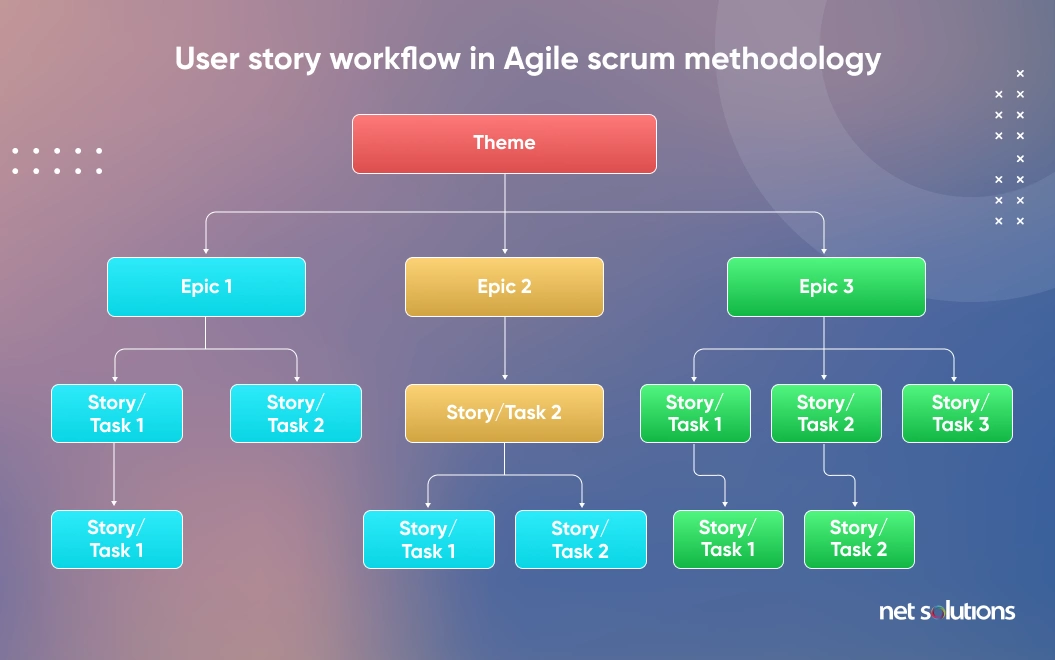
The acceptance criteria generation extends this workflow by taking completed user stories and breaking them into specific, testable conditions.
When you select a user story and request acceptance criteria, Miro AI produces structured conditions like “Given I am on my profile page, when I click the ‘Edit’ button, then the input fields become editable with proper validation feedback” and “Given I upload a new profile photo, when I save changes, then my updated photo displays across all relevant interface elements.”
This feature exemplifies AI augmentation rather than replacement in product management workflows. The AI handles formulaic drafting and structural formatting, freeing product managers to focus on strategic validation, user need assessment, and backlog prioritization.
The generated content serves as a high-quality starting point that teams can immediately refine and validate against actual user research and business objectives. For practical implementation guidance, check out our Miro AI Tutorials and Usecase.
Can Miro AI automatically summarize sticky notes from brainstorming sessions?
This represents one of Miro AI’s most impactful features for maintaining team flow and reducing administrative overhead in collaborative sessions.
After intensive brainstorming, user feedback collection, or agile retrospectives, teams often face hundreds of individual sticky notes that require manual sorting and synthesis—a significant bottleneck that disrupts momentum and delays actionable insights.
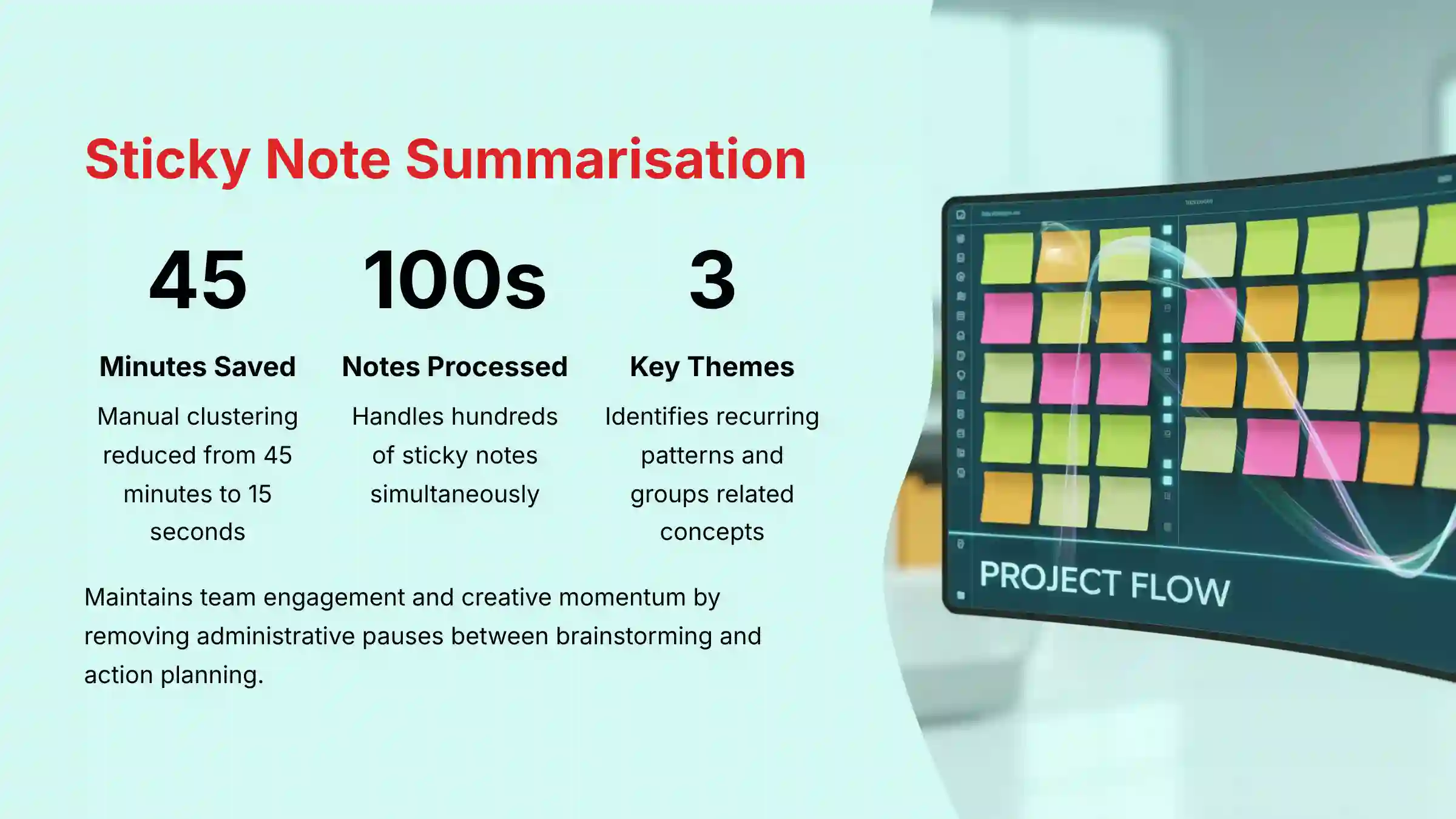
The summarization process eliminates this friction through intelligent automation. You select multiple sticky notes using a drag selection or manual grouping, then choose “Summarize” from the AI menu.
Within seconds, Miro AI analyzes all selected content, identifies recurring themes, groups related concepts, and generates a coherent synthesis presented in a new text box directly on your board.
The AI intelligently handles various content types and contexts. For retrospective sessions, it might identify themes like “communication gaps,” “technical debt concerns,” and “process improvement opportunities” with specific examples from the original notes.
For user feedback sessions, it could synthesize pain points, feature requests, and user journey insights into structured categories that immediately inform product decisions.
This transformation converts a 45-minute manual clustering task into a 15-second automated action, allowing teams to immediately transition from idea generation to strategic discussion of synthesized insights.
The time savings compound significantly across multiple sessions, but more importantly, it maintains team engagement and creative momentum by removing the administrative pause that traditionally occurs between brainstorming and action planning.
Teams can stay in collaborative flow while ensuring no insights are lost in the transition from divergent to convergent thinking.
What are the main differences between Miro AI and FigJam AI?
The fundamental distinction lies in their optimization for different stages of the product development workflow and varying depths of collaborative structure.
While both bring AI to visual collaboration, their strengths reflect their parent platforms’ core philosophies and user bases.
Miro AI emphasizes structure, synthesis, and comprehensive project management workflows. Its capabilities excel in organizing and contextualizing large amounts of collaborative information, generating detailed user stories with acceptance criteria, creating complex sequence diagrams from process descriptions, and building comprehensive mind maps for strategic planning.
The AI integrates deeply with Miro’s extensive template library covering PI Planning, Customer Journey Mapping, and Product Requirements Documents, making it ideal for teams using their visual workspace as a central hub throughout the entire project lifecycle.
FigJam AI focuses on spontaneous ideation and live meeting facilitation with streamlined, intuitive features like rapid sticky note sorting and real-time summarization during active sessions.
Its tight integration with Figma’s design ecosystem creates a seamless path from collaborative ideation directly into detailed design work, making it particularly valuable for design-focused teams who need to maintain creative momentum from brainstorming through visual execution.
The choice depends primarily on workflow complexity and integration needs. Teams requiring comprehensive project management with detailed documentation, complex diagram generation, and long-term board organization benefit most from Miro AI’s depth.
Teams prioritizing rapid creative facilitation with immediate design workflow integration find FigJam AI’s streamlined approach more valuable.
For product managers overseeing complex, multi-phase initiatives with diverse stakeholders, Miro AI provides the structured intelligence needed to maintain strategic alignment. For design teams focusing on creative collaboration with direct handoff to visual development, FigJam AI offers optimized facilitation without unnecessary complexity.

What are the known limitations of Miro AI and where does it require human oversight?
Understanding Miro AI’s limitations is crucial for establishing proper governance and avoiding the “AI autopilot” trap that can lead to strategic missteps.
While powerful as an acceleration tool, it requires careful human oversight and validation to deliver genuine business value.
The primary limitation involves potential “hallucinations” where the AI generates plausible but factually incorrect or nonsensical content, particularly when processing highly technical or domain-specific information without sufficient context.
The AI lacks true business understanding and cannot validate whether generated user stories solve actual user problems or align with strategic objectives—it creates structurally correct content based on patterns rather than strategic insight.
Content quality directly correlates with input quality and specificity. Vague prompts or unrelated sticky note selections produce generic, often unusable results.
The AI cannot interpret complex spatial relationships between ungrouped board elements or understand implicit team knowledge that influences collaborative decisions.
However, recent developments indicate expanded capabilities. Miro AI can perform tasks like creating technical diagrams, interpreting code, and clustering and summarizing board content, suggesting multimodal capabilities that process both text and visual information, though with limitations in nuanced interpretation.
The critical success factor involves treating Miro AI as a sophisticated drafting assistant rather than a strategic decision-maker. Its value lies in generating initial structures—like producing ten user story drafts in 30 seconds—which saves substantial typing time and frees cognitive resources for high-value activities like prioritization, assumption challenging, and strategic alignment validation.
Teams must maintain senior-level oversight, treating AI output as starting points requiring critical evaluation and contextual refinement rather than finished deliverables. For addressing common concerns, review our detailed Miro AI FAQs.
How does Miro AI assist in creating diagrams like user flows and mind maps?
Miro AI dramatically reduces the barrier to creating structured visual representations, transforming natural language descriptions into organized diagrams that help teams visualize complex processes and relationships without manual construction overhead.
For mind map generation, you can begin with a central concept on a sticky note or text element, such as “Q3 Marketing Campaign Launch.” The AI command generates a comprehensive mind map with the central topic as the hub and automatically creates branching sub-topics like “Target Audience Segments,” “Channel Strategy,” “Content Calendar,” and “Success Metrics,” with further sub-branches detailing specific tactics and considerations.
This instant structure provides a framework for deeper strategic exploration.
The sequence diagram capability represents particularly impressive technical functionality for product and engineering teams. You can describe system interactions in plain English: “User authenticates through login form. Browser validates credentials with authentication service. Service queries user database for verification. Database returns user profile data. Service generates secure session token and sends confirmation to browser.”
Miro AI automatically converts this description into proper UML sequence diagrams with correct lifelines for User, Browser, Authentication Service, and Database entities, plus accurately sequenced message arrows representing each interaction step.
This capability bridges communication gaps between technical and non-technical stakeholders by allowing process description in natural language while producing technically accurate documentation.
Product managers can describe user journeys or system workflows conceptually, and the AI generates professional diagrams suitable for developer handoffs and stakeholder presentations.
The time savings prove substantial, but the real value lies in lowering the expertise barrier for creating professional documentation, enabling rapid iteration on process design, and maintaining visual consistency across team communications.
Is Miro AI included in the Free plan and what are the pricing details?
Miro AI is available for Free, Starter, and Business plans through a credit-based system that provides trial access on the free tier with expanded allocations on paid plans.
This accessibility allows teams to evaluate AI capabilities before committing to paid subscriptions.
Free plan users receive a one-time allocation of credits to trial Miro AI features, allowing evaluation of capabilities like summarization, user story generation, and diagram creation.
While this provides substantial exploration opportunity, ongoing professional use requires upgrading to paid plans that include larger monthly credit allocations or unlimited usage depending on the tier.
Enterprise plans include 100 credits/month per member with organization-wide or team-specific AI controls, providing both usage allocation and administrative governance features essential for large-scale deployments.
This enterprise approach addresses compliance and security concerns while ensuring consistent access across teams.
The credit system operates transparently with 1 credit being used for each AI action you perform, making usage predictable and budgetable.
Each AI operation—whether generating summaries, creating user stories, or building diagrams—consumes one credit regardless of complexity, providing clear cost visibility for project planning.
This pricing model offers advantages over complex per-action billing by allowing experimentation without usage anxiety while ensuring sustainable access for regular users.
Teams can evaluate AI impact on their workflows through free tier trials, then scale access through paid plans that align with their collaboration intensity and team size. The enterprise tier’s administrative controls enable governance-conscious organizations to implement AI capabilities while maintaining security and usage oversight.

Is Miro AI secure for confidential product strategy and roadmaps?
Miro AI implements enterprise-grade security measures specifically designed for confidential business information, with data protection policies that address the primary concerns of product and strategy teams handling sensitive roadmaps and competitive intelligence.
The most critical security commitment involves data usage policies. Miro explicitly states that user board content is never used to train third-party AI models, with data processed “in-memory” and not stored or logged by AI providers after request completion.
This zero-training policy ensures that your strategic plans and product roadmaps remain confidential and cannot inadvertently influence AI models accessible to competitors or other organizations.
Data minimization principles limit exposure by transmitting only user-selected content to AI services rather than entire board contents or account information.
Users maintain granular control over what information the AI processes, enabling secure usage even on boards containing mixed confidentiality levels.
Miro maintains comprehensive enterprise certifications including SOC 2 Type II, ISO 27001, and GDPR compliance, establishing systematic approaches to data security and privacy protection.
Enterprise customers receive additional data residency options, enabling geographic control over data storage to meet sovereignty requirements and regulatory compliance needs.
However, security requires shared responsibility beyond vendor capabilities. Organizations should implement internal data classification policies, clearly labeling boards by sensitivity level and establishing usage guidelines for different confidentiality tiers.
While technical risks remain minimal given Miro’s security posture, building security-conscious culture through clear policies and team training ensures responsible AI adoption that protects strategic assets while enabling productivity benefits.
Teams handling highly sensitive information should review Miro’s Trust Center documentation and work with security teams to validate alignment with organizational data protection requirements.
How does Miro AI integrate with essential tools like Jira?
Miro AI enhances the existing Miro-Jira integration by streamlining the content creation phase of the collaborative-to-development workflow, reducing friction in translating brainstormed ideas into structured development backlog items.
The enhanced integration workflow operates across multiple phases. During ideation sessions, teams generate ideas on Miro sticky notes and cards. Miro AI then helps refine these raw concepts into well-structured user stories complete with acceptance criteria, directly within the visual workspace.
This AI-assisted refinement ensures that content destined for Jira meets development team standards before conversion.
The conversion process leverages Miro’s native Jira integration to transform AI-enhanced Miro cards into Jira issues. Key information including titles, descriptions, and AI-generated acceptance criteria maps directly to corresponding Jira fields, maintaining content fidelity through the handoff process.
The resulting Jira cards on Miro boards display real-time status updates, creating bi-directional visibility that keeps stakeholders aligned on development progress.
This workflow addresses a common bottleneck where collaborative outputs require significant manual refinement before becoming actionable development tasks.
By automating the initial structuring and formatting, teams can move from brainstorming to development planning more efficiently while maintaining quality standards that developers expect.
The integration particularly benefits product managers who frequently translate stakeholder feedback and strategic initiatives into technical requirements. AI assistance in creating properly formatted user stories with comprehensive acceptance criteria reduces the manual effort required to bridge collaborative ideation with structured development processes, enabling faster velocity from concept to implementation while maintaining clear communication between business and technical teams.

Is Miro AI compliant with enterprise standards like SOC 2, ISO 27001, and GDPR?
Miro AI operates within comprehensive enterprise compliance frameworks designed to meet the stringent requirements of regulated industries and security-conscious organizations handling sensitive project data and strategic information.
Miro maintains SOC 2 Type II attestation, demonstrating systematic evaluation of security controls over time rather than point-in-time assessment.
This certification validates that Miro’s systems and processes consistently protect customer data according to established security principles including confidentiality, availability, and processing integrity—critical factors for teams managing confidential product roadmaps and strategic initiatives.
ISO 27001 certification establishes Miro’s commitment to systematic information security management through internationally recognized standards.
This framework ensures ongoing risk assessment, security control implementation, and continuous improvement processes that protect both company and customer information assets throughout their lifecycle.
GDPR compliance addresses European data protection requirements through comprehensive privacy controls, user rights support, and lawful data processing practices.
Miro’s data processing agreements and AI-specific policies align with regulatory requirements while enabling cross-border collaboration essential for global product teams.
For healthcare and other regulated industries, Miro offers HIPAA eligibility on Enterprise plans through Business Associate Agreements that ensure Protected Health Information receives appropriate safeguarding according to US healthcare privacy requirements.
Enterprise customers should engage directly with Miro’s Trust Center documentation to review detailed security whitepapers, compliance certificates, and specific policy documents relevant to their regulatory requirements.
Organizations with specific compliance needs should work with their legal and security teams to validate Miro’s security posture against internal requirements and industry regulations before implementing AI features for sensitive project data.
How does Miro AI handle visual content and multimodal capabilities?
Miro AI demonstrates expanding multimodal capabilities that process both textual and visual board content, enabling more comprehensive analysis and generation capabilities for complex collaborative artifacts containing diverse information types.
Miro AI can perform tasks like creating technical diagrams, interpreting code, and clustering and summarizing board content, indicating capabilities that extend beyond simple text processing to include visual interpretation and technical content analysis.
This multimodal approach enables teams to leverage AI assistance across diverse content types commonly found in collaborative project environments.
The visual processing capabilities enable AI to analyze diagrams, understand spatial relationships between board elements, and generate insights from complex visual arrangements that teams create during collaborative sessions.
This represents significant advancement beyond text-only processing, allowing AI to provide contextual assistance for comprehensive board content including charts, workflows, and interconnected visual elements.
However, teams should maintain realistic expectations about visual interpretation accuracy and depth. While the AI can process and respond to visual content, its analysis may lack the nuanced contextual understanding and domain expertise that human team members provide.
Complex technical diagrams or strategically significant visual frameworks require human validation and interpretation to ensure accuracy and appropriate application.
The expanding multimodal capabilities position Miro AI as a more comprehensive collaborative assistant, capable of supporting teams working with diverse content types while maintaining the need for human oversight and validation.
As these capabilities continue developing, teams can expect increasingly sophisticated support for visual collaboration workflows while maintaining appropriate governance and quality control processes.
For teams seeking broader AI collaboration options, explore our comprehensive guide to the Best 10 AI Team Communication Platforms: Strategic Choices for Project & Product Managers in 2025 and discover Best 10 AI Document & Knowledge Collaboration for Project & Product Managers 2025.


Leave a Reply