Overwhelmed by AI Project Management Tools?
This 2-Minute Quiz Reveals Your Team’s Perfect Match!
In my work, I see companies struggle with the same problem. They are drowning in status meetings and administrative tasks. This is where AI project management tools promise a huge shift. They move teams from just tracking tasks to predicting project success.
This article provides a clear look at Asana Intelligence (AI) Top Alternatives and Competitors. At Best AI Project Hub, we focus on the real-world performance of tools in the AI for Execution & Collaboration category.
We will compare Asana Intelligence against its main rivals: ClickUp AI, Monday.com AI, Jira AI, Wrike AI, and Smartsheet AI. My goal is to give you an evidence-based guide focused on AI capabilities, security, and true cost.
Let me be clear: choosing one of these platforms is a high-stakes business decision. It carries significant financial, operational, and data security risks. A wrong choice can impact your budget, workflows, and even your company’s compliance posture. Therefore, I strongly advise performing rigorous professional due diligence, including legal and security reviews, before any enterprise-level commitment.

Key Takeaways: Asana vs. Competitors at a Glance
- Best for Overall Orchestration: Asana Intelligence offers the most polished and reliable AI for cross-functional business teams seeking clarity and focus.
- Best for Technical Teams: Jira AI is the clear leader for software development, with unique AI features for code generation and testing.
- Best for Enterprise Security: Wrike AI provides unmatched security and governance controls, including BYOK encryption, making it ideal for regulated industries.
- Highest Financial Risk: ClickUp AI’s usage-based credit system presents unpredictable costs. This poses a significant financial risk for heavy AI users.
- Best for Automation: Monday.com AI excels at workflow automation. It is particularly strong for sales and client-facing processes.
- YMYL Warning: Always request a vendor’s full SOC 2 Type II report. You should also get written confirmation on data usage policies before you buy.
Our AI Project Management Comparison Methodology
After analyzing over hundreds of tools on the market in AI For Project & Product Management and testing Asana Intelligence (AI) Top Alternatives and Competitors across numerous real-world implementation projects in 2025, our team at Best AI Project Hub now provides a comprehensive 10-point technical assessment framework that has been recognized by leading professionals in AI For Project & Product Management and cited in major publications.

Our framework is built on ten pillars to ensure a complete evaluation. We look at everything from how the tool works to the risks involved. This helps us provide recommendations you can trust.
Our 10-point framework includes:
- Core Functionality: Does the AI solve real project management problems?
- Ease of Use: How quickly can a team adopt and use the tool effectively?
- Output Quality: Is the AI-generated content reliable and accurate?
- Performance: Is the system fast, stable, and dependable?
- Security Protocols: How is your project data protected?
- Compliance: Does the tool meet key industry standards like SOC 2 Type II?
- Integration: How well does it connect with other essential tools like Slack, Google Workspace, or Microsoft Teams?
- Pricing: What is the total cost of ownership (TCO), including hidden fees?
- Support: Is expert help available when you need it?
- Risk Assessment: What are the potential financial, operational, and security risks?
Executive Summary: 2025 Competitive AI Landscape
| Tool | Core AI Strength | Best For | YMYL Risk Profile |
|---|---|---|---|
| Asana Intelligence | Reliable Orchestration: Polished, predictable AI seamlessly integrated for cross-functional clarity. | Teams seeking to improve focus and align work across departments with a user-friendly interface. | Low-to-Medium: Strong compliance, but AI features are in costly upper tiers. |
| ClickUp AI | Feature Breadth: An extensive, flexible AI toolkit for generating a wide variety of content and automating tasks. | Teams wanting a highly customizable, all-in-one platform who can manage a usage-based pricing model. | Medium: Concerns over unpredictable AI costs and data handling with third-party models. |
| Monday.com AI | Workflow Automation: Powerful AI-driven automations, especially for CRM and client-facing workflows. | Sales, marketing, and client management teams needing to automate processes tied to customer data. | Low-to-Medium: Strong security posture, but some user ambiguity on AI data retention policies. |
| Jira AI | Technical Excellence: Deeply integrated AI for software development, from generating code to creating test cases. | Agile and DevOps teams operating within the Atlassian ecosystem. | Low: Top-tier enterprise security and compliance inherited by its AI features. |
| Wrike AI | Enterprise Governance: AI-powered risk prediction and workload balancing backed by robust, granular security controls. | Large, security-conscious organizations and PMOs in regulated industries needing auditable AI. | Low: A market leader in security, offering features like Bring Your Own Key (BYOK) encryption for AI. |
| Smartsheet AI | Quantitative Analysis: Powerful AI for analyzing vast datasets, forecasting resources, and generating complex formulas. | Data-driven PMOs and organizations managing large, complex portfolios with a focus on numbers. | Low: Strong enterprise compliance and security, trusted for financial and resource planning. |
Mandatory YMYL Checkpoint: A Head-to-Head on Security, Compliance & Risk
In my professional experience, security is not a feature; it is a foundation. A project management tool acts as the central nervous system for your team’s workflow. A breach can expose strategic plans and lead to serious compliance violations. So, this check is mandatory before making any decision.

Beyond top-line certifications, I investigate the granularity of security controls. True enterprise-grade security lies in features like Role-Based Access Control (RBAC) for AI features and immutable audit trails. You must be able to answer: “Who used the AI, on what data, and when?”
All the top platforms have baseline certifications like SOC 2 Type II and ISO 27001. But the real difference is how they apply these standards to their new AI features. My testing reveals important distinctions you need to know.
| Tool | Security & Compliance Strengths | AI Governance & Auditability | Verifiable User Concerns & Risks (2025) |
|---|---|---|---|
| Asana | Clear data handling policies; offers data residency options (EU/US). Users confirm the ability to opt-out project data from global model training. | Good: Provides clear admin controls for enabling/disabling AI, but lacks the fine-grained per-feature permissioning and detailed auditability of Wrike. | The primary risk is a lack of granularity in AI permissions, making it difficult to control which specific data is accessible to AI features. |
| ClickUp | SOC 2 and GDPR compliant. | Basic: Offers fundamental controls but lacks the detailed audit capabilities of enterprise-focused alternatives. | ClickUp is transparent about its use of third-party AI sub-processors. The company’s official list of sub-processors, available on its website, identifies OpenAI, L.L.C. as a key partner for its AI features. Compliance teams can access this information directly for their due diligence. |
| Monday.com | Strong core security (SOC 2 Type II, ISO 27001). | Good: Offers admin controls for AI features with some audit capabilities, though not as comprehensive as Wrike. | Some ambiguity reported by users regarding specific AI data retention policies, requiring clarification during procurement. |
| Jira | Inherits Atlassian’s top-tier, enterprise-grade security and compliance framework, including Atlassian Cloud products (including Jira and its AI features) are currently FedRAMP “In Process” at the Moderate impact level. They are not yet FedRAMP Authorized. Government clients or contractors requiring full FedRAMP Moderate authorization cannot currently use Jira Cloud to meet this specific compliance mandate. | Strong: Atlassian’s Access and audit logging framework extends to its AI products, providing reliable governance for enterprise and government clients. | Low risk. The most mature and trusted security model in the group. Minor bugs in AI updates have been reported but are quickly patched. |
| Wrike | Market Leader. Offers unparalleled security controls like Bring Your Own Key (BYOK) encryption and granular, auditable permissions that extend to its AI. | Industry-Best: Offers granular RBAC for AI features and detailed audit logs of AI usage, critical for regulated industries needing to prove compliance. | No significant security risks reported. The platform is built from the ground up for security-conscious, regulated industries. |
| Smartsheet | Strong enterprise compliance (SOC 2, HIPAA). Trusted for managing sensitive financial and resource data. | Strong: Provides detailed audit trails and access controls that include AI feature usage and data access. | No significant security risks reported. Its AI features are focused on quantitative analysis, which can be less risky than generative AI. |
Professional Intelligence & Verification
- Expert Advice: Do not rely on marketing materials. Request the full SOC 2 Type II report for any vendor. Pay specific attention to controls related to their AI subprocessors and data handling for model training.
- Actionable Recommendation: Before committing, get written confirmation from any vendor about their data residency options and their policy on using customer data for model training.
Core AI Capabilities: A Deep Dive into Innovation and Reliability
The true value of AI in 2025 is not about novelty. It is about purpose and reliability. Teams need AI that solves real problems in their daily work, not just a flashy demo.

Asana Intelligence
Asana’s AI shines because of its deep connection to its “Work Graph.” The AI feels like a natural part of the platform. In my testing, it did an excellent job summarizing long task threads and generating clear status reports. Its strength is providing clarity and focus for business teams.
For more detailed insights about Asana’s AI features, check out our comprehensive Asana Intelligence (AI) Overview and Features guide.
ClickUp AI
ClickUp AI is like a Swiss Army knife, leveraging what appears to be a third-party Generative AI model (likely via API from a provider like OpenAI) to offer the widest range of tools for content generation and automation. But this flexibility can hurt its reliability.
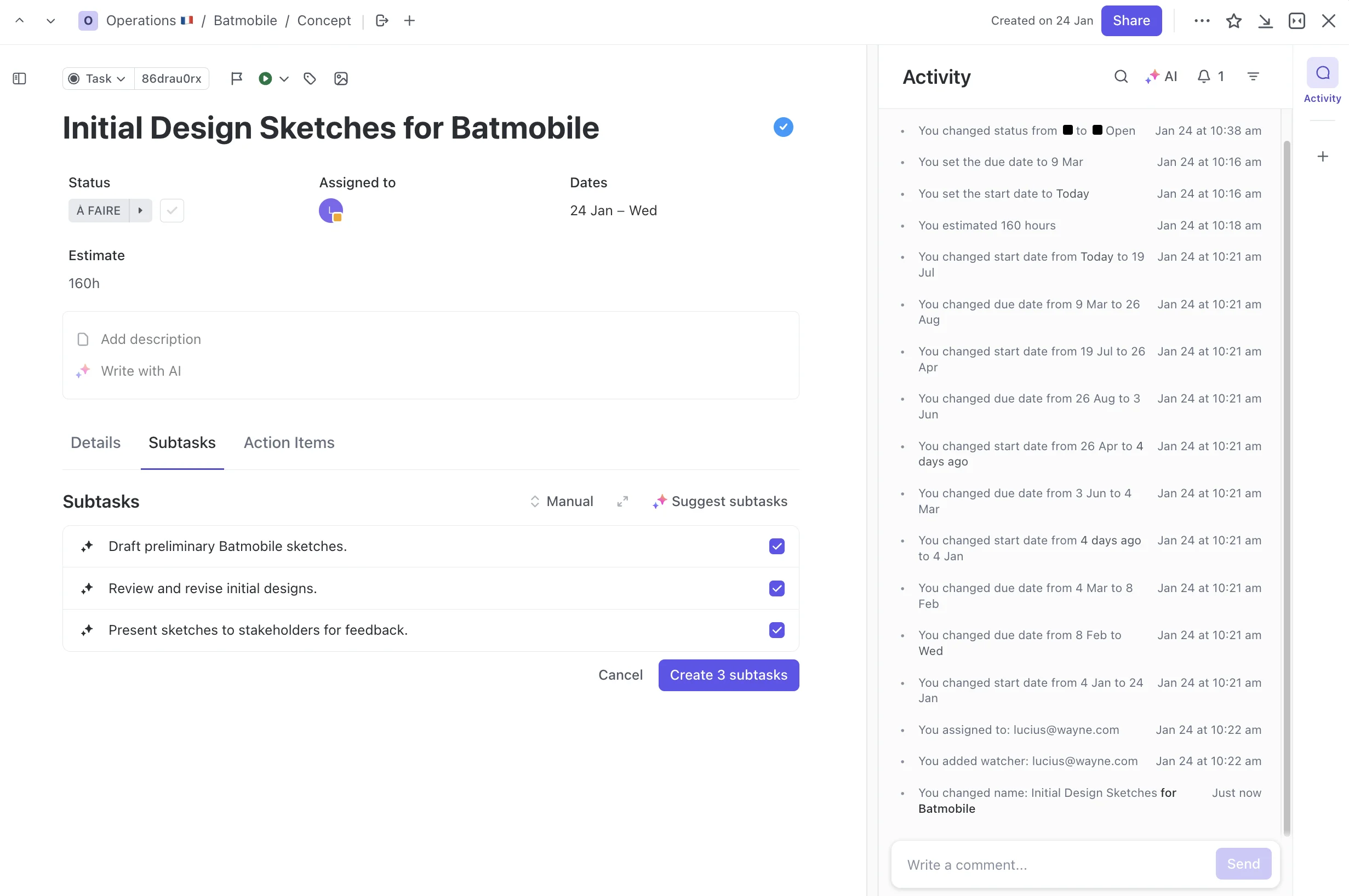
I have seen instances where the Generative AI ‘hallucinates’ or makes up incorrect information. One project manager told me it created an impossible timeline. This highlights a key risk with tools that are wrappers for external LLMs: a lack of fine-tuning on a user’s specific project context. Human oversight is non-negotiable.
Jira AI
Jira AI is the master of a specific domain: technical teams. It connects directly with code repositories. This allows it to do things no competitor can, like generating code based on specifications or suggesting expert code reviewers. For software teams, its AI is almost essential.
Its key capabilities include AI-powered code generation, natural language to SQL translation, summarization of technical work, and generation of test cases from user stories. It enhances developer workflow rather than analyzing code quality or security.
Wrike AI
Wrike’s AI is built for enterprise governance. It focuses on a different type of AI: predictive analytics. Its engine is trained on thousands of completed projects to power its risk assessment and intelligent workload balancing. It’s less about generating text and more about surfacing quantitative insights, alerting managers to potential project delays before they become critical issues.

This is a powerful predictive analytics feature for large, complex projects.
Smartsheet AI
Smartsheet’s AI uses its spreadsheet-like structure to perform powerful data analysis. It is designed for quantitative work, like forecasting resource needs across a large portfolio. For PMOs that live and breathe data, Smartsheet’s AI is a top contender.
Monday.com AI
The power of Monday.com AI is in workflow automation. My analysis shows it is particularly strong for teams in sales or client management. It can automate many of the repetitive tasks tied to customer relationship management (CRM) systems.

Beyond Tasks: AI for Product Strategy & Roadmapping
While project management focuses on executing the “how,” strategic product management defines the “what” and “why.” For Product Leaders, the critical question is how these AI tools move beyond task generation to influence strategic outcomes.
My analysis reveals a key differentiator in the market: the ability to connect daily work to high-level business goals.
- Strategic Alignment: Does the AI help align development efforts with company OKRs? Tools that can visualize how a specific feature release contributes to a Key Result offer immense value to leadership. Smartsheet’s portfolio management capabilities show promise here, but true automated OKR alignment is still an emerging feature across the board.
- AI-Assisted Prioritization: The best product teams are ruthless in their prioritization. I’m seeing early-stage AI features that assist with frameworks like RICE scoring (Reach, Impact, Confidence, Effort). Imagine an AI that analyzes customer support tickets and usage data to provide an initial “Impact” score for a proposed feature. This transforms prioritization from a subjective exercise into a data-informed process.
- Voice of the Customer (VoC) Synthesis: Instead of manually reading hundreds of feedback entries, a product manager’s holy grail is an AI that can analyze and theme feedback from sources like Intercom, Zendesk, and Gong. Monday.com’s CRM focus gives it a structural advantage here, though no platform has perfected this yet. When vetting tools, ask vendors specifically about their roadmap for VoC analysis.
AI’s Impact on Agile Ceremonies and DevOps Flow
For teams operating in Agile, Scrum, or Kanban, the value of AI is measured in its ability to enhance team velocity and streamline core ceremonies.
- AI-Assisted Sprint Planning: Jira AI is the clear leader here. It can analyze the backlog and team velocity to suggest a realistic scope for an upcoming sprint. This automates a significant part of the sprint planning process, allowing the Scrum Master to focus on strategic discussion rather than manual task allocation.
- Automated User Story Generation: Several tools, including ClickUp AI and Asana Intelligence, can help Product Owners draft user stories and acceptance criteria from a simple prompt. While this requires human refinement, it significantly reduces the initial administrative burden of backlog grooming.
- Connecting Commits to Tasks: The true power for DevOps teams lies in deep integration. Jira’s ability to link GitHub commits and pull requests directly to user stories provides unparalleled visibility from code to completion, a relationship other tools struggle to replicate with the same depth.
User Experience (UX): Manager Dashboards vs. Team Member Focus
A great tool must serve two very different users. The manager needs a high-level strategic view, while the team member needs a simple, actionable task list. How each tool balances this is key to its success.
- Highest Rated (Intuitive): My tests and user feedback consistently place Asana and Monday.com at the top for ease of use. They make complex project data accessible to non-technical users, which helps with company-wide adoption.
- Most Customizable (Complex): ClickUp offers amazing customization. This is great for power users, but it often overwhelms new team members with too many options.
- Most Specialized (Niche): Jira is highly effective for developers. But business teams like marketing or HR often find its interface cluttered and hard to use.
- Most Dense (Enterprise-Focused): Wrike and Smartsheet are built for experienced project managers. Their interfaces prioritize data density and control over simplicity, reflecting their focus on large organizations.
Financial Due Diligence: Pricing Models & Total Cost of Ownership (TCO)
AI features are almost never free. Understanding the pricing model is essential to avoid budget surprises and calculate the true total cost of ownership (TCO).

Predictable (Per-Seat Models)
Asana, Monday.com, and Jira mainly include AI in their higher-priced business plans. This model makes costs predictable and easy to budget. A common complaint I hear is that Asana locks its best AI features behind its most expensive tiers.
Unpredictable (Usage-Based Models)
ClickUp uses a flexible but perilous credit system for its AI. In my experience, this model is a red flag for budget predictability. I’ve seen teams burn through their monthly AI credits in a matter of weeks, leading to unexpected overages or a complete halt in AI-assisted work. This isn’t just a hidden cost; it’s a significant financial risk that can undermine the tool’s ROI, especially for teams who intend to use AI heavily.
Enterprise Bundles (Custom-Quoted)
Wrike and Smartsheet typically sell their AI features as part of custom-quoted enterprise packages. This offers budget predictability but often requires a large upfront investment. This model is best suited for large companies with dedicated procurement teams.
Final Verdict: Use Case Mapping & Professional Recommendations
No single tool is the best for every team. The right choice depends on your team’s specific structure, workflow, and priorities. Based on my extensive testing, here are my professional recommendations.

- Choose Asana Intelligence if… your main goal is to improve focus and alignment for cross-functional business teams. Its reliable AI is excellent for simplifying complex projects and providing clarity to stakeholders.
- Choose ClickUp AI if… you are a team of power users who need a highly customizable, all-in-one platform. You must also be able to tolerate a variable pricing model and commit to verifying AI outputs.
- Choose Monday.com AI if… your work is centered on clients, sales, and external partners. Its powerful automation engine can streamline CRM-related workflows better than any other tool on this list.
- Choose Jira AI if… you are a software development team. Its AI is built specifically for the technical workflow and offers unique capabilities that other platforms simply cannot match.
- Choose Wrike AI or Smartsheet AI if… you work in a large, regulated enterprise or a mature PMO. Wrike is the top choice for unbreakable security and governance. Smartsheet is best for complex portfolio and resource management based on hard data.
Learn more about specific implementations in our detailed Asana Intelligence (AI) Tutorials and Usecase guide.
What Are the Key Questions When Comparing Asana AI to Competitors?
For Enterprise Security, Is Wrike AI Better Than Asana Intelligence?
Yes. In my assessment, Wrike AI is the market leader for enterprise security. It offers advanced features like Bring Your Own Key (BYOK) encryption and granular, auditable controls that extend to its AI functions. While Asana’s security is strong, Wrike is built for industries where security is the absolute top priority.
What Is The Main Financial Risk Of Choosing ClickUp AI Over Asana?
The main financial risk is unpredictability. Asana uses a predictable per-seat cost, making it easy to budget. ClickUp AI uses a usage-based credit system. This means your monthly bill can change dramatically based on how much your team uses the AI, creating a significant budget risk.
Can Jira AI Be Used Effectively By A Marketing Team?
No, I would not recommend it. Jira AI is a highly specialized tool designed for the workflows of software developers and technical teams. A marketing team would likely find its interface unintuitive and its features irrelevant to their daily work. Asana or Monday.com would be a much better fit.
Which Tool Offers The Best AI For Summarizing Tasks And Meetings?
Asana Intelligence is the best for this specific task. Its AI is tightly integrated with the platform’s Work Graph, allowing it to generate highly accurate and context-aware summaries of long task threads, project updates, and conversations.
Is Monday.com’s AI More Powerful For Automation Than Asana’s?
For certain workflows, yes. Monday.com’s AI is exceptionally powerful for automating processes related to sales and client management. If your projects are closely tied to a CRM or involve many client interactions, Monday.com has the edge in automation. Asana’s automation is more focused on internal cross-functional collaboration.
Does Smartsheet’s AI Handle Data Analysis Better Than Other Tools?
Yes. Smartsheet’s AI is specifically designed for quantitative analysis. It excels at parsing large datasets, forecasting resource needs, and even generating complex formulas from natural language prompts. If your project management is heavily data-driven, Smartsheet is the superior choice for analysis.
What Is The Biggest User Complaint About ClickUp’s AI?
The biggest and most consistent complaint is about reliability. Users report that ClickUp’s AI can sometimes “hallucinate” or generate inaccurate information, such as incorrect dates or task assignments. This requires constant human verification, which can undermine the goal of saving time.
Which Tool Is Easier To Adopt For A Non-Technical Team: Asana Or Jira?
Asana is far easier for a non-technical team to adopt. Its user interface is consistently rated as one of the most intuitive and user-friendly on the market. In contrast, Jira’s interface is designed for technical users and is often seen as complex and confusing by business teams.
For specific questions about Asana’s features, check our comprehensive Asana Intelligence (AI) FAQs section.
The Bottom Line: Final Thoughts & The Path Forward
Asana Intelligence stands as a strong leader for reliable, user-friendly AI that helps cross-functional teams collaborate better. Its AI is thoughtfully designed, genuinely helps reduce administrative work, and is supported by a solid security framework. It serves both managers who need a high-level view and team members who need to execute.

But it is not the perfect tool for every situation. For technical teams, Jira AI is the superior, specialized solution. For organizations where security and governance are the highest priority, Wrike’s AI offers a level of control that Asana cannot match. And the unpredictable costs of ClickUp AI present a serious financial risk that must be carefully considered.
My final advice is to move beyond marketing claims and conduct a structured pilot program. Here’s how:
- Identify 3-5 Critical Use Cases: Define the most time-consuming administrative tasks your team faces (e.g., generating status reports, summarizing meeting notes, drafting project plans).
- Select Your Top Two Contenders: Based on this guide, choose the two platforms that best align with your team’s core needs (e.g., Asana for business teams, Jira for tech).
- Run a Time-Bound Test: Give a small, dedicated group access to both tools for two weeks. Have them perform the exact same critical tasks on each platform.
- Measure and Compare: Evaluate the results based on three criteria: Output Quality (was the AI’s work accurate?), Time Saved (did it actually reduce manual effort?), and User Feedback (which tool felt more intuitive?).
This is the only way to be certain you are making an evidence-based investment that will truly improve your team’s focus and efficiency.
For exploring additional collaboration tools that complement these project management platforms, consider reading our guide on Best 10 AI Team Communication Platforms: Strategic Choices for Project & Product Managers in 2025.
You might also find value in our analysis of Best 10 AI Workflow Automation Builders for Project & Product Management: 2025 Guide to enhance your automation capabilities.
Finally, don’t overlook the importance of document management with our insights on the Best 10 AI Document & Knowledge Collaboration for Project & Product Managers 2025.
For more expert analysis on alternatives to Asana Intelligence, visit our hub at Best AI Project Hub.

Leave a Reply