
Is Asana Intelligence the Right AI for Your Team?
Take This Quick Quiz to Find Out!
Key Takeaways
- AI-Powered Project Management: Asana Intelligence transforms reactive task tracking into predictive project success with Smart Projects, Smart Summaries, and Smart Answers.
- Enterprise Security & Privacy: Comprehensive data isolation protocols ensure your strategic roadmaps and project details remain exclusively within your organization’s boundary.
- Intelligent Task Assignment: AI analyzes historical patterns, workload distribution, and project membership to suggest optimal task owners while maintaining human oversight.
- Advanced Plan Value: At $24.99/month, Advanced plan includes full AI Studio access with comprehensive Smart features and workflow automation without additional AI-specific charges.
- Human-in-the-Loop Design: All AI suggestions require explicit approval, maintaining strategic control while accelerating project planning and execution decisions.

What is Asana Intelligence (AI) and what are its main AI features?
Asana Intelligence is an integrated suite of AI-powered capabilities within the Asana work management platform, designed specifically to transform project execution from reactive task tracking into predictive project success. Rather than simply organizing tasks, Asana AI features such as Smart Projects help teams proactively identify risks, automate workflows, and generate intelligent insights that increase project completion rates.
The core AI features serve both management oversight and team member execution needs. For project managers, Smart Summaries instantly distill lengthy project threads and complex status updates into actionable insights, while Smart Answers provide data-driven responses to natural language queries like “What are the biggest blockers on our Q4 launch?” For individual contributors, Smart Editor assists in drafting clearer task descriptions and project updates, reducing administrative overhead and enabling focus on deep work.

The AI also powers workflow automation through intelligent field population and rule suggestions. When team members create tasks, the system automatically suggests appropriate assignees based on historical patterns, workload analysis, and project membership. Smart project planning capabilities can break down high-level goals into structured sub-tasks, effectively creating initial project plans from a single strategic objective.
For teams looking to explore comprehensive Asana Intelligence (AI) Overview and Features, the platform’s integration of AI throughout the project lifecycle represents a significant advancement in work management technology.
Importantly, Asana Intelligence operates within Asana’s established permission structure, ensuring users can only query or summarize projects they already have access to view. This maintains data security while providing intelligent assistance throughout the project lifecycle, from strategic planning to execution and reporting.
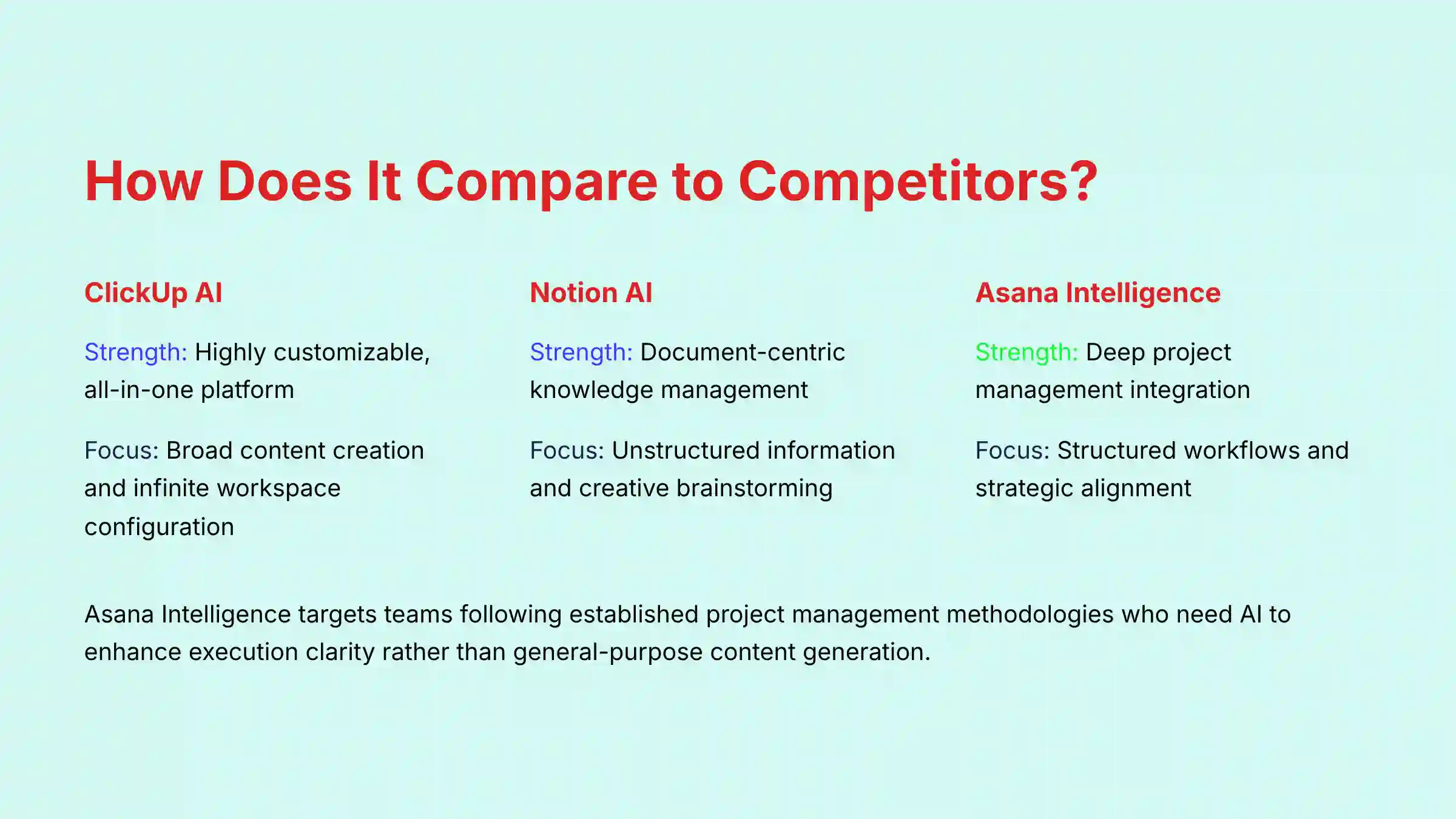
How does Asana Intelligence (AI) compare to other AI tools like ClickUp AI or Notion AI?
Asana Intelligence distinguishes itself through deep integration within structured work management workflows, whereas competitors focus on different core strengths that serve distinct project management philosophies.

ClickUp AI excels in a highly customizable, all-in-one platform environment. Its AI capabilities span broad content creation – from marketing copy to technical documentation – within an infinitely configurable workspace. However, this flexibility can create complexity that requires significant setup time. Asana Intelligence, conversely, focuses specifically on optimizing core project management workflows: improving task clarity, automating status reporting, and aligning daily execution with strategic goals.
Notion AI operates within a document-centric, knowledge management framework. Its strength lies in organizing unstructured information, summarizing research notes, and supporting creative brainstorming within flexible pages. This makes it excellent for teams prioritizing documentation and knowledge sharing. Asana Intelligence works within structured data models of projects, tasks, and goals, enabling more contextually relevant project insights such as identifying at-risk deliverables or generating progress reports based on concrete completion metrics.
The critical difference lies in methodology alignment. ClickUp AI serves teams requiring extensive customization and broad functionality. Notion AI supports teams emphasizing documentation and flexible collaboration. Asana Intelligence targets teams following established project management methodologies (Agile, Scrum, traditional PMO frameworks) who need AI to enhance execution clarity and strategic alignment rather than provide general-purpose content generation.
For project managers who need predictive risk alerts, automated resource allocation suggestions, and intelligent progress tracking, Asana Intelligence offers purpose-built solutions integrated into proven project management structures. To explore detailed comparisons, check out our comprehensive Asana Intelligence (AI) Top Alternatives and Competitors analysis.
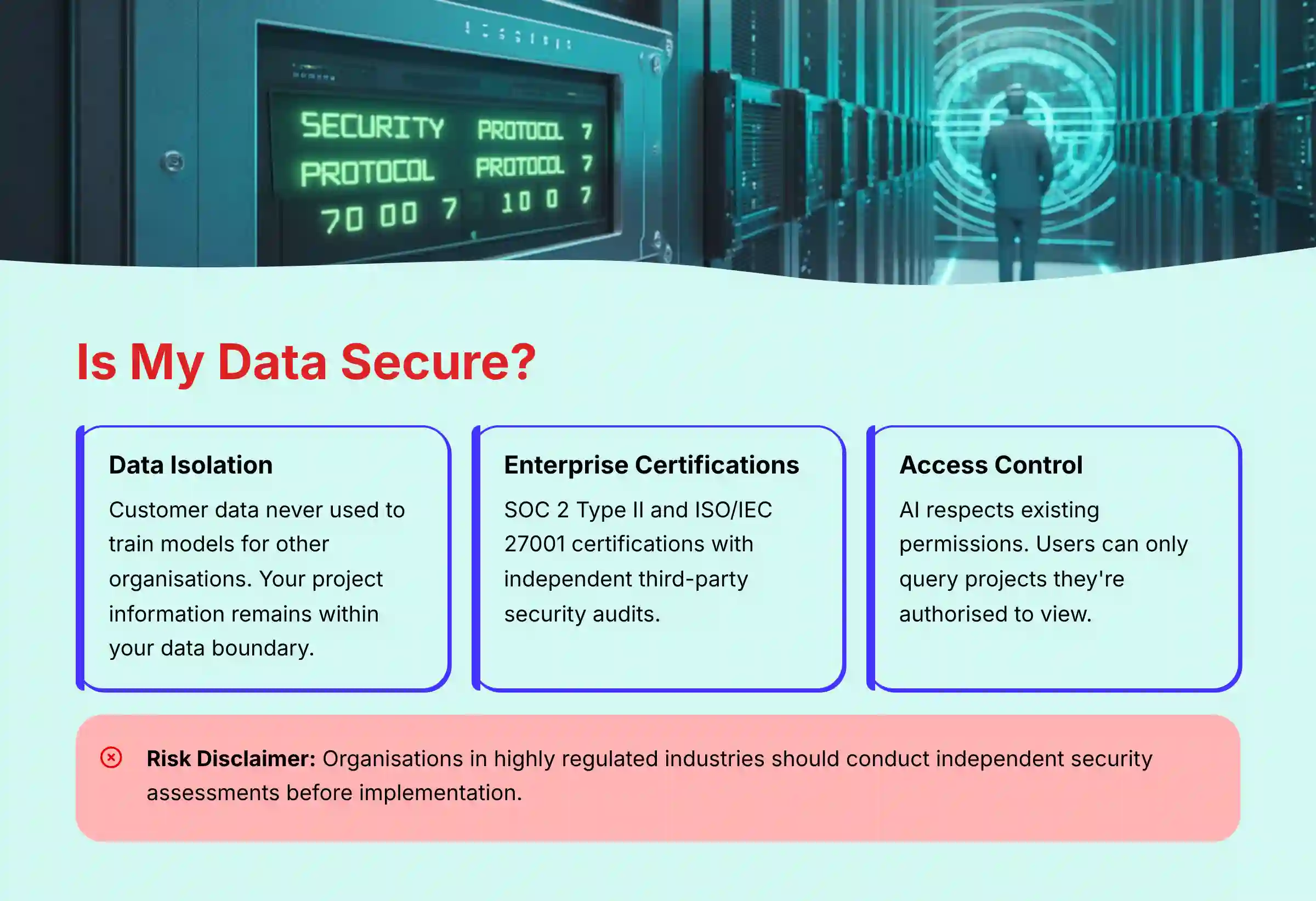
Is my project data secure and private when using Asana Intelligence (AI)?
Data security and privacy are fundamental to Asana Intelligence, particularly critical since project data often includes confidential strategic roadmaps, product plans, and internal communications that could significantly impact business operations if compromised.
Asana implements comprehensive data isolation protocols for AI processing. Customer data is not used to train models for other organizations – your project information remains exclusively within your organization’s data boundary. The AI models may utilize anonymized, non-customer datasets for general functionality, but specific project details, strategic plans, and team communications are never shared across customer boundaries.
The platform maintains enterprise-grade security certifications including SOC 2 Type II and ISO/IEC 27001, which undergo independent third-party audits to verify security controls. For organizations with regulatory compliance requirements, Asana offers GDPR compliance and data residency options, allowing eligible customers to store primary data within European data centers.
Access control integration ensures AI features respect existing permission structures. Team members can only query or request summaries for projects they already have authorization to view. The AI cannot and will not expose confidential information to unauthorized users, maintaining the same granular access controls applied to manual data access.
Risk Disclaimer: While Asana provides robust security measures, organizations operating in highly regulated industries or handling classified information should conduct independent security assessments to ensure alignment with specific compliance requirements. Security standards and threats evolve continuously, making it essential to verify current certifications and controls directly with Asana’s security team before implementation.

What are the common limitations of Asana Intelligence (AI), and where does it struggle?
Understanding Asana Intelligence limitations is crucial for setting realistic expectations and maximizing ROI from AI implementation. The primary constraints fall into contextual understanding, strategic creativity, and data quality dependencies that project managers must account for in their workflows.
Contextual limitations are significant. The AI operates exclusively within Asana’s data ecosystem, lacking access to external context from email threads, Slack conversations, or offline strategic discussions. This means task assignment recommendations or risk assessments may miss critical human factors – for instance, knowing that a team member is currently developing specialized skills that make them ideal for upcoming tasks, or understanding that apparent project delays actually reflect strategic pivots discussed in executive meetings.
Strategic and creative planning represents another constraint area. While Asana Intelligence excels at breaking down well-defined goals into logical task sequences (like “organize product launch event” into venue booking, speaker coordination, and marketing activities), it struggles with highly ambiguous or innovative strategic planning. It cannot invent novel product strategies or create breakthrough approaches to complex business challenges. The AI serves as an execution accelerator, not a replacement for human strategic thinking and creative problem-solving.
Data quality dependency creates a “garbage in, garbage out” scenario. AI effectiveness directly correlates with workspace data hygiene. Inconsistent task naming, unclear project descriptions, and irregular custom field usage result in less accurate summaries and recommendations. Teams must maintain structured data practices – standardized naming conventions, clear project descriptions, and consistent field usage – to maximize AI value.
The system also cannot account for external factors affecting project timelines, team capacity changes due to organizational restructuring, or market conditions that might alter project priorities. These limitations require human oversight and judgment to ensure AI suggestions align with current business reality.
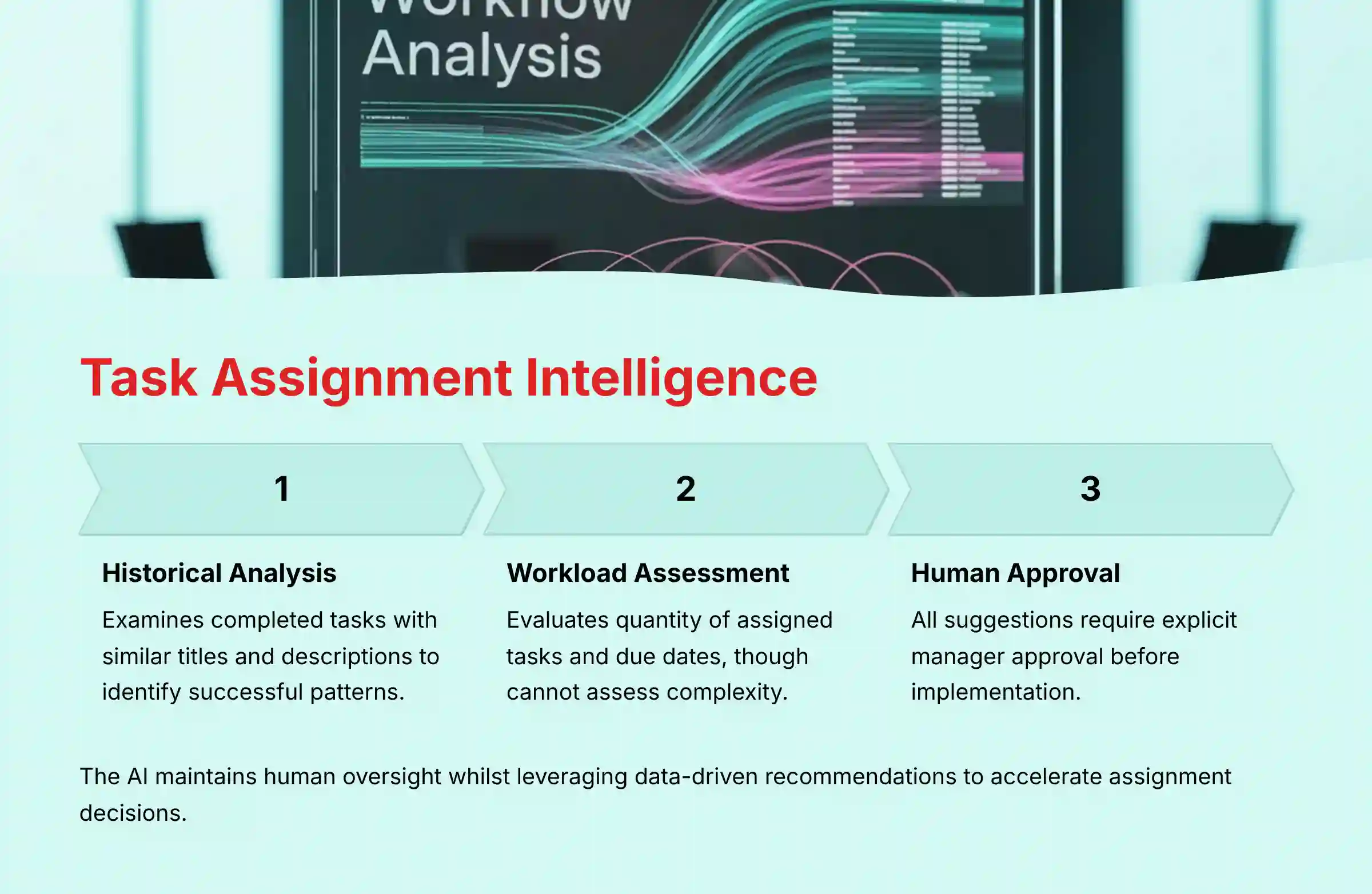
How does Asana Intelligence (AI) decide who to assign tasks to?
Asana Intelligence employs a recommendation-based approach rather than autonomous task assignment, maintaining human oversight while accelerating the assignment decision process. This “human-in-the-loop” methodology ensures accountability while leveraging AI to reduce manual effort in identifying optimal task owners.
The AI analyzes multiple data points to generate assignment suggestions. Historical task ownership patterns provide the primary input – the system examines completed tasks with similar titles, descriptions, and custom field values to identify team members who have successfully handled comparable work. If specific individuals consistently complete “UI design” tasks or “client communication” activities, they’ll be prioritized for similar future assignments.
Current workload analysis factors into recommendations, though with important limitations. The system can assess the quantity of assigned tasks and their due dates to estimate capacity, but cannot evaluate task complexity or effort requirements. A team member with few assigned tasks might actually be handling highly complex, time-intensive work that isn’t reflected in simple task counts.
Project membership and team structure influence suggestions to ensure recommendations remain relevant to existing workflows. The AI prioritizes individuals already involved in specific projects or teams, maintaining continuity and reducing the likelihood of suggesting assignments to completely disconnected team members.
Skills and expertise recognition happens implicitly through task completion patterns rather than explicit skill profiles. The system learns team member capabilities by analyzing the types of tasks they successfully complete, but this approach can miss newly developed skills or changing role responsibilities.
Implementation Note: These suggestions require explicit manager approval before implementation. The AI cannot automatically assign tasks, ensuring project managers retain full control over resource allocation decisions while benefiting from data-driven assignment recommendations.
Can Asana Intelligence (AI) automatically generate a full project plan or create sub-tasks from a single goal?
Asana Intelligence provides robust project planning acceleration through intelligent task breakdown capabilities, effectively solving the “blank page” problem that often delays project initiation. This feature transforms high-level strategic objectives into structured, actionable work plans while maintaining human oversight for refinement and customization.
The process begins with clear goal articulation. Users create parent tasks with descriptive names such as “Launch Q3 Content Marketing Campaign” or “Implement New Customer Onboarding Process.” The AI then analyzes the goal description and generates logical task sequences based on common project patterns and best practices.
For marketing campaign example, the AI might generate sub-tasks including: “Define Campaign Objectives and KPIs,” “Research Target Audience Demographics,” “Develop Core Messaging Strategy,” “Create Visual Asset Requirements,” “Establish Content Calendar,” “Configure Analytics Tracking,” and “Plan Performance Review Schedule.” Each generated task provides a foundation for further customization by project managers.
The feature works most effectively for well-understood, process-driven initiatives where standard methodologies exist. Marketing campaigns, product launches, event planning, and software deployment projects typically yield comprehensive, immediately useful task breakdowns. For highly innovative or unique initiatives, generated plans provide valuable structural foundations even if they require significant customization.
Advanced plan at $24.99/month includes AI Studio access, which enhances project planning capabilities with more sophisticated workflow automation and intelligent task generation features.
Generated task lists appear as drafts requiring explicit approval before implementation. Project managers review, edit, add, or remove tasks based on specific requirements, then assign responsibilities and establish deadlines. This approach transforms hours of manual planning into minutes of AI-assisted refinement while maintaining strategic control over project execution.

What is the pricing for Asana Intelligence (AI), and are AI features included in all plans?
Understanding Asana’s AI pricing structure is crucial for project and product managers making software procurement decisions, particularly as pricing models and feature availability have evolved significantly in 2025.
Critical Pricing Update: Advanced plan at $24.99/month includes AI Studio access, marking a significant shift in Asana’s AI strategy. Unlike many competitors who charge separate AI add-ons, core Asana Intelligence features are now integrated into the Advanced plan tier at $24.99 per user per month (billed annually).
The current pricing structure operates as follows:
Personal Plan (Free): No AI features included. Limited to basic task management for up to 10 team members, suitable for small teams evaluating Asana’s core functionality.
Starter Plan ($10.99/month per user): Asana AI features such as Smart Projects are included at this tier, though with usage limitations and reduced functionality compared to higher plans.
Advanced Plan ($24.99/month per user): Full AI Studio access includes comprehensive Smart Summaries, Smart Answers, Smart Editor capabilities, and advanced workflow automation features. This tier provides the complete Asana Intelligence experience without additional AI-specific charges.
Enterprise Plans: Custom pricing includes all AI features plus advanced security controls, compliance certifications, and dedicated customer success support.
ROI Consideration: The Advanced plan investment should be evaluated against time savings and productivity improvements. Teams spending significant hours on status reporting, project planning, and task coordination often recover the subscription cost through reduced administrative overhead and improved project completion rates.
For detailed insights into maximizing value from Asana’s AI capabilities, explore our Asana Intelligence (AI) Tutorials and Usecase guide.
Risk Disclaimer: Software pricing and packaging change frequently. Organizations should verify current pricing directly with Asana before making procurement commitments, as feature bundling and cost structures may differ from published information.
How can I audit or review AI-generated actions before they are implemented in Asana Intelligence (AI)?
Asana Intelligence prioritizes human oversight through comprehensive audit and review mechanisms, ensuring project managers maintain full control over AI-assisted decisions while benefiting from intelligent automation. This approach addresses governance requirements and risk management concerns common in enterprise project management environments.
The system operates on a “suggestion-first” principle for critical actions. When generating project plans, task assignments, or status updates, the AI presents recommendations requiring explicit human approval. For instance, AI-generated sub-task lists appear as drafts within parent tasks, allowing project managers to review, modify, add, or remove items before accepting the plan. No tasks are automatically created or assigned without deliberate user confirmation.
Attribution and transparency features provide clear visibility into AI assistance. Content generated with AI support includes explicit indicators showing which elements received AI assistance. Status updates drafted using Smart Editor display “AI-assisted” labels, ensuring team members understand the content source and can evaluate information accordingly.
Version history and activity tracking maintain comprehensive audit trails. All changes made based on AI suggestions appear in project activity feeds with clear attribution to the accepting user and timestamp. This creates accountability chains essential for project governance and enables retrospective analysis of AI recommendation effectiveness.
Enterprise-level controls offer additional governance capabilities. Advanced and Enterprise plans include administrative settings allowing IT teams to configure AI feature availability across different teams or projects. Organizations can establish policies requiring senior approval for AI-generated content in sensitive projects or disable specific AI capabilities for compliance-critical workstreams.
Best Practice Implementation: Establish formal review workflows for AI-assisted project planning by creating dedicated “AI Plan Review” tasks assigned to senior team members. This creates systematic checkpoints ensuring strategic alignment and quality control while maintaining AI acceleration benefits.
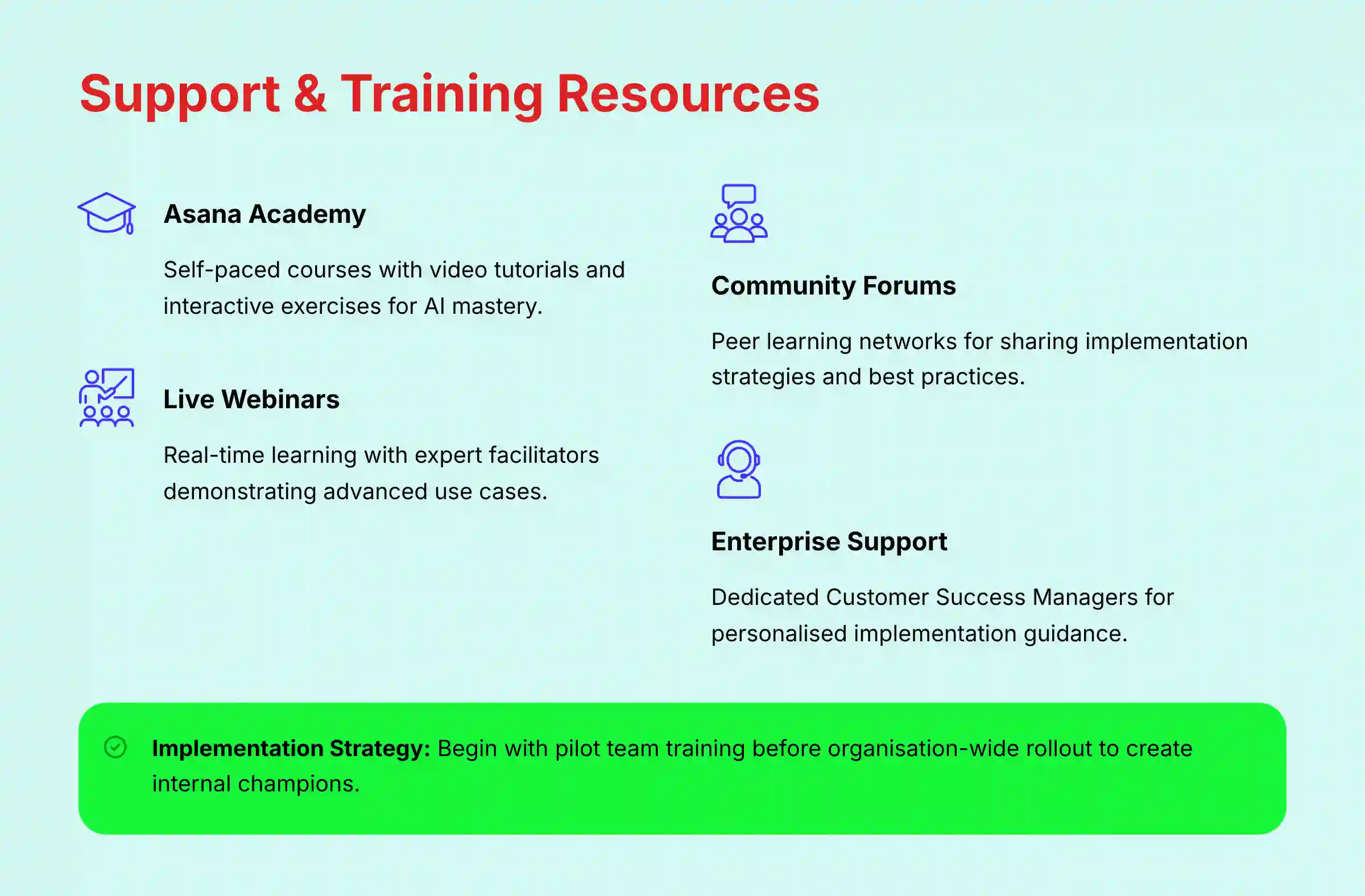
What kind of support and training resources are available to help my team adopt Asana Intelligence (AI)?
Successful Asana Intelligence adoption requires comprehensive training and support resources that address both technical functionality and strategic implementation across different team skill levels and organizational contexts.
Asana Academy provides foundational learning through structured, self-paced courses specifically designed for AI feature mastery. The “Getting Started with AI in Asana” curriculum includes video tutorials, interactive exercises, and practical implementation examples. These courses address both individual contributor needs (efficient task management, clear communication) and management requirements (team oversight, strategic alignment).
Live webinars and workshops offer real-time learning opportunities with expert facilitators. Asana regularly hosts “AI in Practice” sessions demonstrating advanced use cases, methodology integration (Agile, Scrum, traditional PMO), and troubleshooting common implementation challenges. Recorded sessions provide on-demand access to specialized topics like “AI for Cross-functional Project Management” and “Optimizing Team Workflows with Smart Automation.”
Community forums and peer learning networks enable knowledge sharing among practitioners. The Asana Community platform facilitates discussions about AI implementation strategies, workflow optimization tips, and industry-specific applications. Project managers can connect with peers facing similar challenges and share effective AI utilization patterns.
In-application guidance provides contextual learning during actual work. Asana uses progressive disclosure and interactive tooltips to introduce AI features at relevant moments, reducing learning curve friction and encouraging natural adoption patterns.
Enterprise Customer Success Management offers personalized implementation support for larger organizations. Dedicated Customer Success Managers provide strategic consultation, change management guidance, and customized training programs. These experts help establish AI governance policies, optimize workflow configurations, and measure adoption success through relevant KPIs.
For teams exploring broader AI communication solutions, consider reviewing our comprehensive guide to the Best 10 AI Team Communication Platforms: Strategic Choices for Project & Product Managers in 2025 to complement your Asana Intelligence implementation.
Implementation Strategy: Begin with pilot team training before organization-wide rollout. Select early adopters who can become internal champions, providing peer-to-peer support and demonstrating AI value to skeptical team members.
Related Resources
Enhance your project management capabilities with these additional AI-powered resources:
- Explore advanced Best 10 AI Workflow Automation Builders for Project & Product Management: 2025 Guide to complement your Asana Intelligence setup
- Discover comprehensive Best 10 AI Document & Knowledge Collaboration for Project & Product Managers 2025 solutions for enhanced team collaboration
- Access detailed Asana Intelligence (AI) Review for in-depth analysis and user experiences
- Get comprehensive answers in our Asana Intelligence (AI) FAQs section


Leave a Reply