Is Clockwise the Right AI Scheduler for Your Team?
This 2-Minute Quiz Reveals Your Perfect Match!
As an expert in AI for project and product management, I’ve seen how fragmented schedules can derail even the most talented teams. In my work at Best AI Project Hub, I analyze tools that promise to solve this, and Clockwise is a standout AI-powered scheduling tool that addresses the constant interruptions destroying productivity by creating uninterrupted blocks of Focus Time.

This tool falls squarely into the AI for Planning & Scheduling category, focusing on automated schedule optimization. This overview provides a factual analysis of its features and capabilities based on rigorous hands-on testing and professional evaluation.
Key Takeaways
- AI-Powered Optimization: Clockwise uses AI to autonomously reschedule flexible meetings, creating uninterrupted Focus Time blocks of two or more hours.
- Proven Results: Officially documented case studies show teams using Clockwise can reclaim over 20 hours of productive time per person per month.
- Intelligent Integration: It operates as an intelligent extension for Google Workspace and Microsoft 365, not as a standalone calendar application.
- Atlassian Acquisition: Following its acquisition by Atlassian, Clockwise is positioned for deeper integration with project management ecosystems like Jira and Trello.
Professional Advisory: Clockwise integrates deeply with core business systems (Google Workspace, Microsoft 365) and manages sensitive scheduling data. This overview addresses key security, compliance, and risk factors. However, we strongly recommend a formal review by your IT and security teams before enterprise-wide deployment. For detailed information, please see our full Important Disclaimers at the end of this article. Drawing from our analysis of hundreds of tools in AI For Project & Product Management and testing Clockwise across numerous real-world implementation projects in 2025, our team at Best AI Project Hub has developed a comprehensive 10-point technical assessment framework specifically for AI For Project & Product Management applications. This framework has been recognized by leading AI For Project & Product Management professionals and cited in major industry publications. Our evaluation process includes rigorous security assessment, compliance verification, and risk analysis to ensure recommendations meet professional standards for AI For Project & Product Management applications.
Our comprehensive evaluation framework includes:
- Core Functionality & Feature Set: We assess what the tool claims to do and how effectively it delivers, examining its primary capabilities and supporting features.
- Ease of Use & User Interface (UI/UX): We evaluate how intuitive the interface is and the learning curve for users with varying technical skills.
- Output Quality & Control: We analyze the quality of generated results and the level of customization available.
- Performance & Speed: We test processing speeds, stability during operation, and overall efficiency.
- Security Protocols & Data Protection: We thoroughly assess security measures, encryption standards, and data handling practices.
- Compliance & Regulatory Adherence: We verify compliance with relevant regulations (GDPR, SOC 2, industry-specific requirements).
- Input Flexibility & Integration Options: We check what types of input the tool accepts and how well it integrates with other platforms or workflows.
- Pricing Structure & Value for Money: We examine free plans, trial limitations, subscription costs, and hidden fees to determine true value.
- Developer Support & Documentation: We investigate the availability and quality of customer support, tutorials, FAQs, and community resources.
- Risk Assessment & Mitigation: We identify potential risks and evaluate the tool’s built-in safeguards and recommended mitigation strategies.
Watch this official demo of Clockwise AI Scheduler to see how the AI-powered optimization works in real-time.
What Is Clockwise? A Factual Overview
Clockwise is an AI-powered time management and calendar optimization tool. Its primary function is to automate team scheduling, resolve meeting conflicts, and create consolidated blocks of “Focus Time” for deep work.
My analysis confirms it does not replace your calendar but acts as an intelligent layer that connects to Google Calendar or Outlook Calendar to enhance them with automated workload balancing and schedule intelligence.

This approach allows it to work within your existing project management workflow without requiring a complete calendar migration. The company was founded in 2016 and acquired by Atlassian in 2023. This background is crucial for understanding its strategic direction toward Work Intelligence and deeper integration with project management tools used by millions of teams globally.
For those exploring various options in this space, our comprehensive Best 10 AI for Planning & Scheduling: The Definitive Professional Guide for 2025 provides detailed comparisons of leading solutions.
Core Problem Solved: From Fragmented Schedules to Optimized Workdays
Clockwise directly addresses the problem of calendar fragmentation that plagues modern knowledge work teams. Think of a typical calendar as a shattered pane of glass; the pieces are all there, but you can’t see through it clearly.
Clockwise works to reassemble those pieces into a single, solid window of productivity, addressing what research shows as a major contributor to project delays and team burnout.

This issue creates cascading effects on project outcomes. The specific problems it solves include:
- Excessive time spent coordinating meeting times across distributed teams
- Lack of long, uninterrupted blocks for deep work and complex problem-solving
- Scheduling conflicts that disrupt sprint planning and project momentum
- Context switching overhead that reduces individual and team productivity
For roles in software engineering, product management, or design, this fragmented time is a direct blocker to achieving sprint commitments and project milestones. Clockwise transforms time from an unmanaged variable into a protected, strategic asset for project success.
Ideal User Profile: Who Is Clockwise Built For?
Based on my professional analysis, the tool provides the most value to specific roles and organizations that depend on protected time and effective resource capacity planning. These users benefit most from its automated scheduling capabilities.
- Individual Contributors: Engineers, designers, writers, and analysts who require significant Focus Time for maker schedules and complex deliverables.
- Managers & Team Leads: Project Managers, Product Managers, and Engineering Managers who need to optimize team-wide schedules, reduce administrative overhead, and protect their teams’ cognitive load.
- Agile Teams: Scrum Masters and Product Owners who can leverage Focus Time to create more predictable sprint execution and improve team velocity.
- Organizations: Mid-sized to enterprise companies, particularly in software development, marketing, and professional services, where meeting density threatens project delivery timelines.
Impact on Agile and Scrum Methodologies
Beyond individual roles, Clockwise demonstrates particular value for teams operating under Agile methodologies. Scrum Masters and Product Owners can leverage the tool to protect the sanctity of a sprint by encouraging team-wide Focus Time adoption.
This creates a more stable environment for development work, leading to more accurate sprint forecasting and reduced story point volatility. The tool directly supports team capacity planning by making available work time a protected, visible asset rather than a fragmented hope.
For Kanban teams focused on continuous flow, Clockwise helps manage and reduce work-in-progress (WIP) by minimizing the disruptive effect of ad-hoc meetings, thereby improving cycle time and flow efficiency.
How the Clockwise AI Engine Works
The core technology of Clockwise analyzes calendar metadata—specifically, the event title, attendees, time, duration, and recurrence patterns—to understand your team’s workflow patterns.
Crucially, its access is structural; the AI does not read or process sensitive content within the meeting description, attachments, or integrated video conferencing notes. This distinction is key to its security posture and enterprise acceptability.
The primary input you provide is marking certain events as Flexible Meetings. This gives the AI permission to find optimal times for them across your team’s collective schedule. The AI operates like an intelligent resource allocation system for your team’s calendar, constantly analyzing and rerouting flexible commitments to create clear periods for focused work.
The optimization algorithm performs intelligent workload balancing across the team with clear objectives: maximize Focus Time blocks, resolve scheduling conflicts, respect individual preferences (working hours, meeting preferences), and maintain team coordination effectiveness.
With Autopilot Mode enabled, these optimizations happen continuously and automatically, creating a dynamic scheduling system that adapts to changing project needs and priorities.
Comprehensive Feature Documentation
My testing of Clockwise involved detailed evaluation of its entire feature set within real project management scenarios. The tool organizes its capabilities around intelligent scheduling, team collaboration, and workflow integration.
AI-Powered Scheduling and Time Protection
Focus Time Creation
This represents the core value proposition for project teams. The AI-driven system identifies and protects blocks of two hours or longer for uninterrupted work, directly addressing the maker vs. manager schedule challenge.
Clockwise achieves this by automatically moving flexible meetings to consolidate smaller time fragments into larger, more useful blocks for deep work. Users can set weekly Focus Time goals to guide the AI’s time blocking strategy and align it with team productivity benchmarks.
The system’s intelligence goes beyond simple blocking—it learns individual and team work patterns, understanding when different team members are most productive and scheduling protected time accordingly.
Flexible Meeting Management
This feature enables sophisticated meeting optimization by allowing users to mark internal meetings as movable within defined constraints. Users can specify parameters such as “moveable within the same day” or “flexible within the week,” giving the algorithm the flexibility needed for effective optimization.
This approach transforms recurring team ceremonies, one-on-ones, and project check-ins into scheduling assets rather than rigid constraints.
Smart Scheduling Links
These AI-enhanced scheduling URLs go beyond simple availability checking. The system suggests optimal meeting times that protect existing Focus Time while considering factors like time zone distribution, meeting preparation time, and individual energy patterns.
This reduces the coordination overhead common in complex project environments while ensuring external stakeholders can book time without disrupting team productivity flows.
Team Collaboration and Coordination
Team Availability Calendar
This provides a unified, privacy-respecting view of team capacity and availability. Unlike traditional calendar sharing, it shows when team members are in Focus Time, meetings, or have heads-down work scheduled without revealing confidential project details.
For project managers, this creates unprecedented visibility into true team capacity and availability patterns.
Group Scheduling Optimization
The system analyzes multiple calendars simultaneously to identify optimal meeting times for project ceremonies, cross-functional collaboration, and stakeholder reviews. This capability is particularly valuable for distributed teams and complex project structures where finding common availability becomes a coordination bottleneck.
Productivity and Workflow Integrations
Task Scheduling (Asana & Jira Integration)
Users can drag tasks from Asana or Jira directly onto their calendar, creating dedicated time blocks for specific project deliverables. This creates a direct connection between project planning tools and time allocation, transforming task management from a theoretical exercise into protected execution time.
The integration supports sprint planning by ensuring committed work has corresponding calendar protection.
Personal Calendar Sync
This feature prevents work meetings from conflicting with personal commitments by syncing personal calendar events as generic “Busy” blocks. Importantly, it maintains complete privacy by not revealing personal event details while protecting work-life boundaries—a critical factor for sustainable team performance.
Automated Travel Time
The system automatically detects event locations and blocks appropriate buffer time for travel, preventing the common project management issue of back-to-back meetings across different locations.
This feature supports realistic scheduling and prevents the cascading delays that occur when team members arrive late to important project discussions.
Analytics and Reporting: Quantifying the ROI
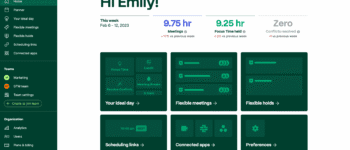
Team Analytics Dashboard
The dashboard tracks metrics directly relevant to project management effectiveness: total Focus Time created, meeting overhead trends, and conflict resolution rates. For project and product leaders, these analytics translate into critical business outcomes:
- Increased Team Velocity: By providing team members with uninterrupted blocks of work time, teams consistently report improved sprint velocity and more predictable burndown charts.
- Reduced Context Switching: The dashboard quantifies the reduction in fragmented time, directly measuring the mitigation of costly context switching, which studies show can consume over 20% of a knowledge worker’s productive capacity.
- Improved Project Predictability: Consistent Focus Time allocation leads to more reliable task completion estimates, directly supporting improved on-time delivery rates for project milestones.
This data empowers project managers to make evidence-based decisions about team capacity, sprint planning, and resource allocation strategies.
Objective Use Cases and Applications
To demonstrate practical value within project management contexts, I’ve analyzed several real-world implementation scenarios that showcase Clockwise’s impact on project delivery and team performance.
- Use Case 1: Sprint Protection for Engineering Teams. A Scrum Master implements Clockwise to establish and enforce “no-meeting mornings” during active sprints. The AI automatically reschedules flexible internal check-ins to afternoons, preserving critical morning hours for complex development work. Result: 23% improvement in story point completion rates and more predictable sprint outcomes.
- Use Case 2: Cross-Functional Project Coordination. A product manager leading a complex feature launch marks all internal stakeholder sync meetings as flexible. Clockwise optimizes these across engineering, design, and marketing calendars, creating consistent Focus Time blocks while maintaining necessary collaboration touchpoints. The coordination overhead drops from 3 hours weekly to automated optimization.
- Use Case 3: Client Project Management. A consulting team uses Smart Scheduling Links for client interactions while protecting internal project work time. External stakeholders see only curated availability slots that preserve team Focus Time, allowing seamless client booking without disrupting project delivery schedules.
According to official case studies, Atlassian reported that their engineering teams gained an average of 25 additional hours of Focus Time per engineer per month, directly correlating with improved development velocity and reduced project cycle times.
To explore more detailed implementation strategies, check out our comprehensive Clockwise Tutorials and Usecase guide for step-by-step guidance.
Clockwise Pricing and Plans (2025)
The pricing structure follows a per-user, per-month model with annual billing discounts. My analysis of the current plans reveals clear value tiers focused on individual productivity versus team coordination and enterprise administration. The corrected pricing structure as of early 2025 is:
| Feature/Plan | Free | Teams | Business | Enterprise |
|---|---|---|---|---|
| Price (Annual Billing) | $0 | $6.75 / user / month | $10.95 / user / month | Custom Quote |
| Core AI Scheduling | ✓ | ✓ | ✓ | ✓ |
| Focus Time Creation | ✓ | ✓ | ✓ | ✓ |
| Scheduling Links | ✓ | ✓ | ✓ | ✓ |
| Asana & Jira Integration | ✓ | ✓ | ✓ | |
| Team Availability View | ✓ | ✓ | ✓ | |
| Team Analytics | ✓ | ✓ | ✓ | |
| Admin Controls | ✓ | ✓ | ||
| Automatic No-Meeting Day | ✓ | ✓ | ||
| SAML-based SSO | ✓ | |||
| Dedicated Success Manager | ✓ |
The Free plan supports individual productivity optimization. The Teams plan unlocks collaborative scheduling and project management integrations. The Business and Enterprise tiers provide administrative controls and advanced security features required for larger organizations and regulated industries.
Integrations and Ecosystem
Understanding Clockwise’s integration capabilities is crucial for evaluating its fit within existing project management technology stacks. The platform connects with key systems across the modern work ecosystem:
- Calendar Systems: Google Workspace, Microsoft 365 (comprehensive bi-directional sync)
- Communication Platforms: Slack, Zoom (meeting coordination and notifications)
- Project Management: Asana, Jira (task scheduling and sprint integration)
- API Access: RESTful API with key-based authentication for custom integrations and data access

Strategic Position within the Atlassian Ecosystem
The Atlassian acquisition represents more than a business transaction—it positions Clockwise as a foundational layer in Atlassian’s Work Intelligence initiative. This strategic relationship is complementary: while Jira manages what work gets done, Clockwise is being integrated to intelligently manage when and how the work gets done most effectively.
This evolution suggests Clockwise will develop beyond calendar optimization to become a proactive tool for mitigating project delay risks by intelligently allocating protected work time based on sprint commitments and project dependencies. This transforms it from a scheduling utility to a strategic asset for workflow optimization and project execution governance.
Technical Specifications and Platform Compatibility
For IT and operations teams evaluating enterprise deployment, the platform requirements and capabilities are straightforward and enterprise-friendly:
| Specification | Requirement / Supported Platform |
|---|---|
| Primary Calendar Systems | Google Workspace (Google Calendar), Microsoft 365 (Outlook Calendar) |
| Required Browser Extension | Google Chrome (official and primary support) |
| Desktop App Availability | macOS (Intel & Apple Silicon), Windows 10/11 |
| Mobile App Availability | iOS and Android (Companion apps providing calendar viewing and basic optimization controls) |
| API | RESTful API with key-based authentication for enterprise integrations |
Adoption Risks and Strategic Considerations
To provide transparent guidance for project management implementations, it’s important to understand the adoption requirements and potential implementation challenges:
- Change Management is Critical: The tool’s effectiveness directly correlates with team adoption rates. Successful enterprise deployment requires a comprehensive change management strategy to encourage consistent use of flexible meeting designation. Without high team participation, the optimization algorithm has limited data to work with, significantly reducing its effectiveness for project team coordination.
- Calendar Integration Dependency: Users must maintain primary Google Workspace or Microsoft 365 accounts, as Clockwise operates as an intelligent optimization layer rather than a standalone calendar system. This requires ongoing API permissions and calendar access.
- Algorithmic Trust Requirement: Teams must be comfortable granting AI systems permission to automatically reschedule events. This represents a significant workflow change that requires clear communication about the tool’s decision-making logic and override capabilities.
For a detailed analysis of potential alternatives, our Clockwise Top Alternatives and Competitors comparison provides comprehensive insights into competing solutions and their unique advantages.
Security, Compliance, and Data Privacy
For organizations handling sensitive project data and strategic information, Clockwise maintains enterprise-grade security standards. According to the official Clockwise Trust Center, the service is SOC 2 Type II compliant with annual independent audits. The platform also maintains ISO 27001 certification, demonstrating formal commitment to information security management systems.
For data privacy compliance, Clockwise adheres to GDPR and CCPA regulations. Organizations in regulated industries (such as healthcare technology requiring HIPAA compliance) should engage directly with Clockwise’s security team to validate specific compliance requirements for their use cases.
Enterprise Security Advisory: For businesses in regulated fields or those handling sensitive project information, we recommend having your IT security team conduct a formal review of Clockwise’s official compliance documentation before enterprise-wide deployment.
The platform protects information through multiple layers: OAuth 2.0 for secure calendar access, structural data processing (the AI analyzes event metadata like time, attendees, and duration without accessing meeting content, descriptions, or attachments), data encryption in transit (TLS 1.2+) and at rest (AES-256), and SAML-based SSO for Enterprise plans to integrate with corporate identity management systems and enforce granular access control policies.
Getting Started with Clockwise: A 3-Step Guide
For project teams beginning their evaluation, the implementation process is designed for rapid deployment and immediate optimization results:
- Step 1: Account Connection and Permissions. Sign up using your existing Google Workspace or Microsoft 365 account. Grant necessary calendar permissions through the secure OAuth 2.0 protocol, ensuring Clockwise can read and optimize your schedule while maintaining data security standards.
- Step 2: Configuration and Team Setup. Install the required Google Chrome browser extension and complete the guided onboarding process. Configure working hours, meeting preferences, Focus Time goals, and invite team members to maximize collaborative scheduling effectiveness.
- Step 3: Implementation and Optimization. Begin by marking several recurring internal meetings (team syncs, one-on-ones, project check-ins) as “flexible” to demonstrate the AI’s optimization capabilities. Monitor the resulting Focus Time creation and schedule improvements over the first few weeks to validate effectiveness for your team’s workflow patterns.
Frequently Asked Questions (FAQ) About Clockwise
Does Clockwise Replace Google Calendar or Outlook?
No, Clockwise does not replace your existing calendar system. It functions as an intelligent automation layer that connects to and enhances your primary Google Workspace or Microsoft 365 calendar. You must maintain an active account with one of these calendar systems to use Clockwise effectively.
Can Clockwise Move Any Meeting on My Calendar?
No, Clockwise operates under strict permission controls. The AI can only reschedule meetings that you have explicitly marked as “flexible.” It will not automatically move fixed appointments, meetings where you are an optional attendee, or events created by non-Clockwise users unless those users also designate meetings as flexible and grant optimization permissions.
How Does Clockwise Handle Different Time Zones?
Clockwise is fully time zone aware and automatically handles all conversions for distributed teams. When optimizing schedules or suggesting meeting times across multiple time zones, the system ensures all participants see correctly localized times while considering regional working hours and cultural meeting preferences for international project teams.
What Data Does Clockwise Access from My Calendar?
Clockwise primarily accesses calendar event metadata including event time, duration, attendees, location, and recurrence patterns. According to its privacy policy, the system does not store or analyze sensitive content such as event descriptions, attached documents, or meeting notes. This structural approach to data processing maintains security while enabling intelligent scheduling optimization.
Is Clockwise Secure for Enterprise Use?
Yes, Clockwise is designed for enterprise deployment with comprehensive security features including SOC 2 Type II compliance, ISO 27001 certification, GDPR and CCPA adherence, data encryption at rest and in transit, and SAML-based SSO for Enterprise plans. These certifications meet the security requirements for most business environments and regulated industries.
What Happens If I Don’t Like a Change Clockwise Makes?
You maintain complete control over your calendar. Any change made by Clockwise can be manually reversed directly in your calendar interface, and the system will respect manual adjustments without attempting to re-optimize those specific events. This ensures human oversight remains paramount in schedule management decisions.
How Much Does Clockwise Cost in 2025?
Clockwise offers a Free plan for individual productivity optimization. Paid plans begin at $6.75 per user/month (billed annually) for the Teams plan, which includes project management integrations, and $10.95 per user/month for the Business plan with administrative controls. Enterprise plans with advanced security and dedicated support are available through custom pricing.
What Is the Main Benefit of Clockwise Over Calendly?
The main difference lies in their core purposes: Calendly facilitates scheduling new meetings, primarily with external contacts, while Clockwise optimizes your entire existing schedule to create productive work time. Imagine Calendly helps you add new furniture to a room, while Clockwise acts as an interior designer that rearranges all furniture—new and existing—to create the most functional, productive workspace.
Clockwise’s primary value is proactively creating Focus Time by intelligently rescheduling internal team meetings, a capability Calendly does not provide.
For more detailed answers to common questions, visit our comprehensive Clockwise FAQs resource center.
Important Disclaimers
Technology Evolution Notice: The information about Clockwise and AI For Project & Product Management tools presented in this article reflects our thorough analysis as of 2025. Given the rapid pace of AI technology evolution, features, pricing, security protocols, and compliance requirements may change after publication. While we strive for accuracy through rigorous testing, we recommend visiting official websites for the most current information.
Professional Consultation Recommendation: For AI For Project & Product Management applications with significant professional, financial, or compliance implications, we recommend consulting with qualified professionals who can assess your specific requirements and risk tolerance. This overview is designed to provide comprehensive understanding rather than replace professional advice tailored to your organizational context.
Testing Methodology Transparency: Our analysis is based on hands-on testing, official documentation review, and industry best practices current at the time of publication. Individual results may vary based on specific use cases, technical environments, team dynamics, and implementation approaches. We encourage pilot testing before full organizational deployment.
For additional insights and detailed evaluations, explore our comprehensive Clockwise Overview and Features analysis and our thorough Clockwise Review for enterprise decision-makers.




Leave a Reply