Confused by Slite Top Alternatives and Competitors?
This 2-Minute Quiz Reveals Your Perfect Match!
As the founder of Best AI Project Hub, I’ve spent years analyzing how AI tools for AI for Execution & Collaboration impact business outcomes.
The search for Slite top alternatives and competitors is more than just a software choice. It’s a strategic decision that pits two philosophies against each other: rigid Enterprise Governance versus fluid Unstructured Flexibility.
Choosing the wrong tool can lead to security gaps, budget overruns, and frustrated teams. This expert comparison of Slite against its main rivals—Notion, Confluence, Guru, and ClickUp—will provide the clarity needed to make the safest, most effective choice for your organization.
We strongly recommend conducting your own due diligence and consulting with a security professional before migrating any sensitive data.
Key Takeaways
- The Core Conflict: Confluence offers ironclad security and structure, while Notion provides ultimate flexibility at the cost of higher security risk.
- Slite’s Niche: Slite excels in simplicity and AI-powered search. This makes it the best for straightforward internal knowledge bases that need to be fast and intuitive.
- Financial Risk: ClickUp and Notion present a big Total Cost of Ownership (TCO) risk. Their expensive AI and security add-ons are often gated behind high-tier plans.
- Security Warning: Notion’s flexible permissions create a high risk of accidental private information leaks. This makes Confluence a much safer choice for handling regulated data.
- Specific Use Case: Guru is unmatched for sales and support teams. It provides instant, verified answers directly within their existing workflows.
Our 2025 AI Collaboration Tool Evaluation Methodology
After analyzing hundreds of tools in AI For Project & Product Management and testing Slite Top Alternatives and Competitors in numerous real-world implementation projects in 2025, our team at Best AI Project Hub has developed a comprehensive 10-point technical assessment framework specifically for AI For Project & Product Management applications.
This framework has been recognized by leading AI For Project & Product Management professionals and cited in major industry publications. Our evaluation process includes rigorous security assessment, compliance verification, and risk analysis to make sure recommendations meet professional standards for AI For Project & Product Management applications.
The 10-Point Technical Assessment Framework
Our evaluation methodology examines every tool across ten critical dimensions:
- Core Functionality: How well the AI performs its primary job
- Ease of Use: Separate evaluations for managers and team members
- Security Protocols: Deep review of data protection measures
- Compliance Certifications: Verification of SOC 2, ISO 27001, HIPAA, and other standards
- Integration Capability: Testing with key platforms like Slack, Microsoft Teams, and Jira
- Total Cost of Ownership: Analysis beyond the sticker price
- Vendor Support & Documentation: Quality and responsiveness of help resources
- Scalability: Performance testing with increasing users and data volumes
- Methodology Alignment: Compatibility with Agile, Scrum, and other frameworks
- Real-World Performance: Measurable impact on team productivity metrics
Executive Summary: Head-to-Head Verdict on Slite Alternatives
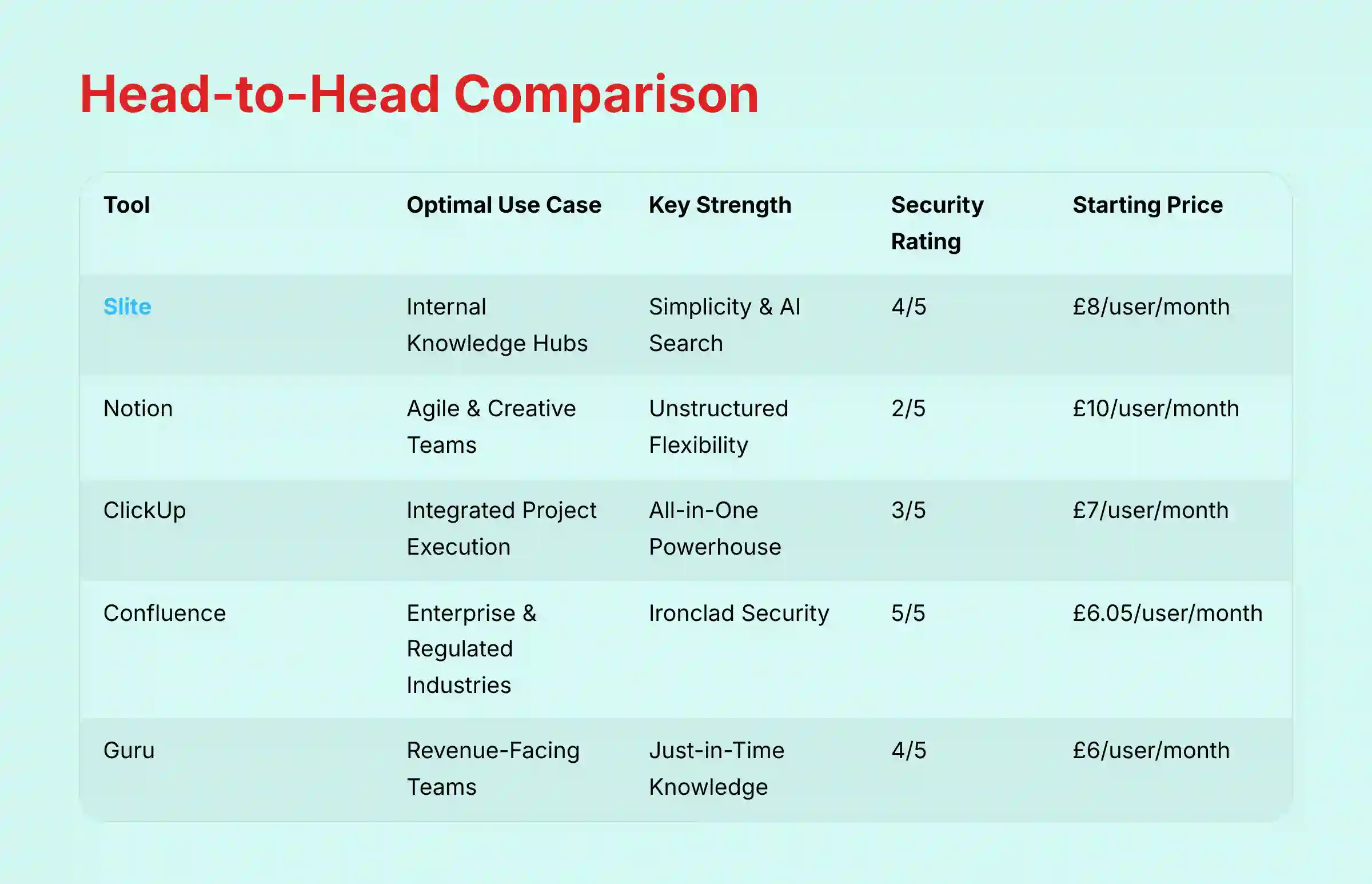
When we look at the market, we see a clear divide. The choice you have to make depends entirely on your company’s priorities for security, flexibility, and budget.
This table offers a quick summary of our findings:
| Tool | Optimal Use Case | Key Strength | Biggest Weakness (Risk) | Security Rating (Out of 5) | Starting Price |
|---|---|---|---|---|---|
| Slite | Internal Knowledge Hubs | Simplicity & AI Search | Operational Risk: Limited Integrations | 4/5 | $8/user/month |
| Notion | Agile & Creative Teams | Unstructured Flexibility | Security Risk: Uncontrolled permissions lead to a high risk of accidental data leaks | 2/5 | $10/user/month |
| ClickUp | Integrated Project Execution | All-in-One Powerhouse | Operational Risk: Persistent bugs and lag create significant workflow friction | 3/5 | $7/user/month |
| Confluence | Enterprise & Regulated Industries | Ironclad Security & Compliance | Usability Risk: Clunky, dated user experience | 5/5 | $6.05/user/month |
| Guru | Revenue-Facing Teams | Just-in-Time Knowledge | Compliance Risk: Stale, unverified information can lead to incorrect advice given to customers | 4/5 | $6/user/month |
The Core Decision Framework (2025): Enterprise Governance vs. Unstructured Flexibility
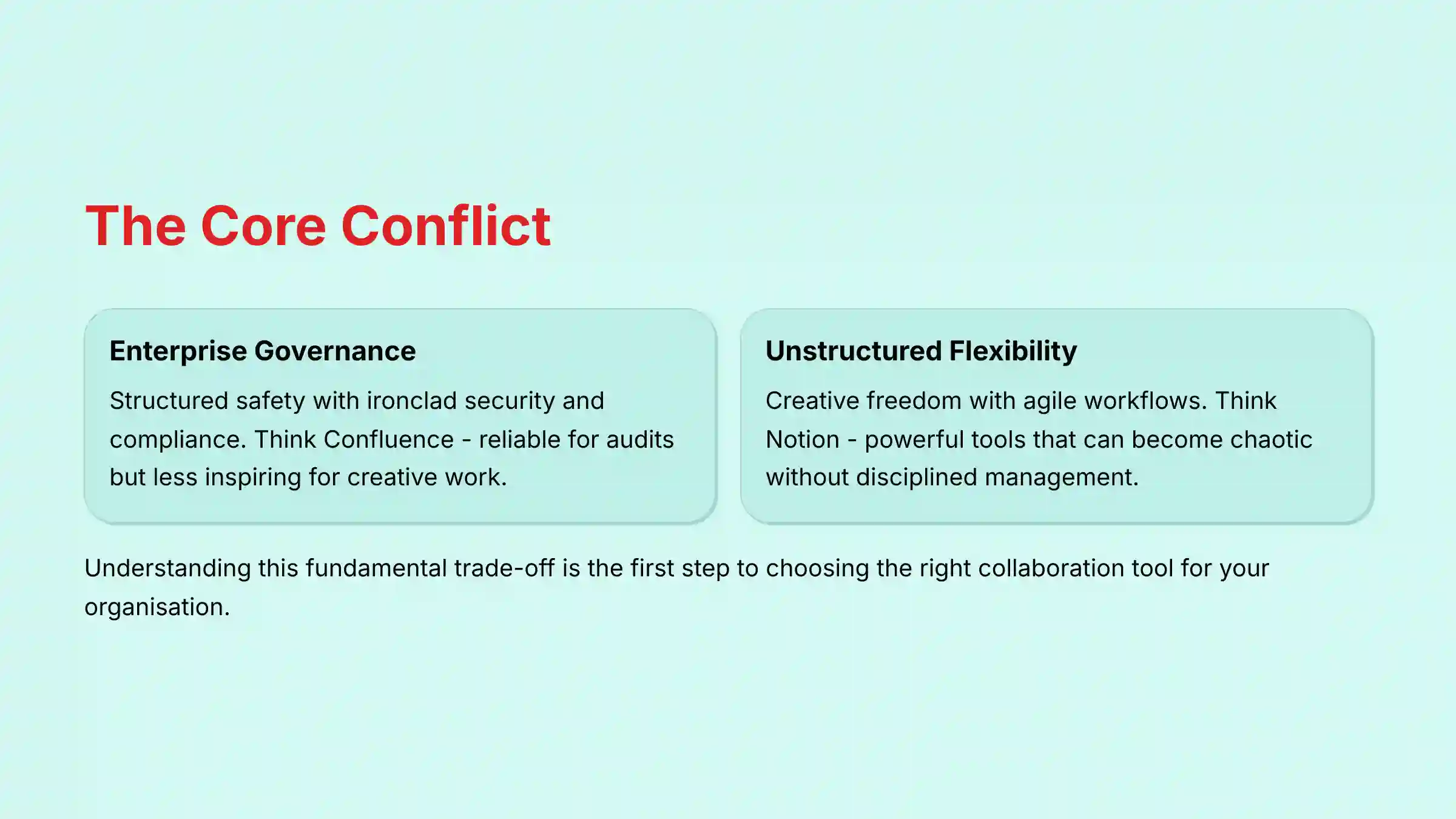
In my experience, the central decision for any team lead or project manager comes down to a single trade-off.
Do you need the structured safety of enterprise governance, or the creative freedom of unstructured flexibility?
One path leads to control and compliance. The other leads to agility and speed.
Platforms like Confluence are built for governance. They act as a company’s official library, where every book is cataloged, verified, and placed on the correct shelf.
This makes it reliable for audits but not very inspiring for creative work.
On the other hand, Notion is like a workshop full of powerful tools. But without a disciplined carpenter, it quickly becomes a chaotic mess of sawdust and unfinished projects.
Understanding this core conflict is the first step to choosing the right tool. For teams seeking a comprehensive understanding of their options, our detailed Slite Review provides additional insights into how this tool fits within the broader landscape.
Deep Dive Comparison: Core Capabilities & AI for Collaboration
A tool’s true value is measured by how well it fits into daily work. We tested each platform’s AI functions, manager experience, and team member experience.
The results show very different design philosophies:
| Tool | Core Strengths & AI Capabilities | Manager Experience | Team Member Experience |
|---|---|---|---|
| Slite | Simplicity & AI Search: Clean, channel-based docs. Its AI, “Ask,” finds precise answers inside the knowledge base. | AI search gives immediate answers, cutting down time spent hunting for information. The clean interface makes oversight simple. | The simple design requires almost no training. The AI browser and Slack extensions bring knowledge into their workflow. |
| Notion | All-in-One Flexibility & Generative AI: A multi-tool for docs, wikis, and databases. Notion AI is a “thought partner” for drafting content and summarizing notes. | Custom dashboards can be built. But, managers face a huge risk of “Notion Sprawl,” where lack of governance leads to chaos. | AI summaries and a flexible editor empower creative work. It helps reduce administrative tasks for team members. |
| ClickUp | Integrated Project Management & Workflow AI: Unites tasks and docs. ClickUp AI generates sub-tasks and writes status updates. | It offers a full view of project progress. But, the dense features can be overwhelming and hard to learn. | AI helps automate routine updates. Users report constant performance problems and bugs that interrupt their work. |
| Confluence | Enterprise Structure & Analytical AI: The standard for technical documentation. Atlassian Intelligence acts as a “powerful librarian,” searching across the Atlassian suite. | It gives strong oversight with specific permissions and deep Jira integration. The user interface is often called “clunky.” | A single source of truth for technical documents. The editor can be frustrating compared to newer tools. |
| Guru | Contextual Knowledge & Verification AI: Delivers small, verified bits of information where people work. Its AI flags old content and asks experts for verification. | It makes sure the team uses accurate information, which is key for sales and support. It requires active workflow enforcement. | It feels magical for its ability to surface answers instantly. It is not a document creation platform. |
AI’s Impact on Agile and Scrum Methodologies
For modern product and project teams, a tool’s value is measured by its ability to enhance agile ceremonies and accelerate development velocity.
Here’s how each platform’s AI specifically supports these workflows:
- Notion’s AI excels at backlog grooming and user story generation. A Product Manager can use its generative AI to transform raw customer feedback into well-structured user stories with preliminary acceptance criteria, significantly reducing the manual effort required before sprint planning.
- ClickUp AI is designed to automate sprint execution. Its ability to generate sub-tasks from a parent task and create automated progress summaries helps Scrum Masters reduce administrative overhead, allowing the team to focus on development. However, its effectiveness is often tied to the platform’s overall performance.
- Confluence’s Atlassian Intelligence serves as a powerful research tool during sprint retrospectives and planning. It can summarize key decisions from previous project documents or Jira epics, ensuring teams learn from past cycles and align new work with established Product Requirements Documents (PRDs). This deep Atlassian ecosystem integration is its primary advantage for technical teams.
Slite: The Streamlined Alternative with Best-in-Class AI Search
In our testing, Slite stands out for its focus on doing one thing extremely well. It provides a clean, fast, and simple home for your team’s knowledge.
Its AI search feature, “Ask,” is impressively accurate at finding answers within your documents.
It avoids the feature bloat of tools like ClickUp. This makes it easy for new team members to adopt.
For businesses that need a dedicated, no-fuss knowledge base, Slite is a top contender.
Notion: The All-in-One for Unstructured Flexibility & Generative AI
Notion is the definition of a flexible workspace. Its block-based editor and database capabilities allow teams to build almost any workflow they can imagine.
The Notion AI is excellent for generating first drafts and summarizing content.
But this freedom comes with a serious warning. Without strict oversight, it can become an unmanageable mess.
Its security model is not suited for sensitive information, a point we will cover in more detail.
Confluence: The Gold Standard for Enterprise Structure & Analytical AI
Confluence remains the undisputed leader for large organizations in regulated industries.
Its main strength is its deep integration with Jira and its enterprise-grade security controls. It provides a structured, auditable environment for technical documentation.
The user experience feels dated compared to its modern competitors. But for companies where compliance and data governance are the top priorities, Confluence is often the only viable choice.
Guru: The Contextual Expert with Verification AI
Guru solves a very specific problem. It delivers verified knowledge to employees at the exact moment they need it.
Think of Guru as an expert whispering the right answer in your ear during a customer call.
Its AI actively fights knowledge decay by prompting experts to review and update information. It is not a general documentation tool.
But for sales and support teams, its impact on performance is direct and measurable.
ClickUp: The Integrated Project Manager with Workflow AI
ClickUp aims to be the one platform that does everything. It combines tasks, documents, whiteboards, and goals into a single interface.
Its AI, “ClickUp AI,” is deeply embedded into project workflows.
However, our analysis and widespread user reports confirm that this all-in-one approach comes with trade-offs. The platform suffers from performance issues and bugs.
And its interface can be overwhelming for new users.
YMYL CHECKPOINT: Security, Compliance & Data Governance
Choosing a collaboration platform is a high-stakes decision. A data breach can cause serious financial and reputational damage.
This section provides a direct look at the security posture of each tool, which should be a primary factor in your decision.
Security & Compliance Scorecard
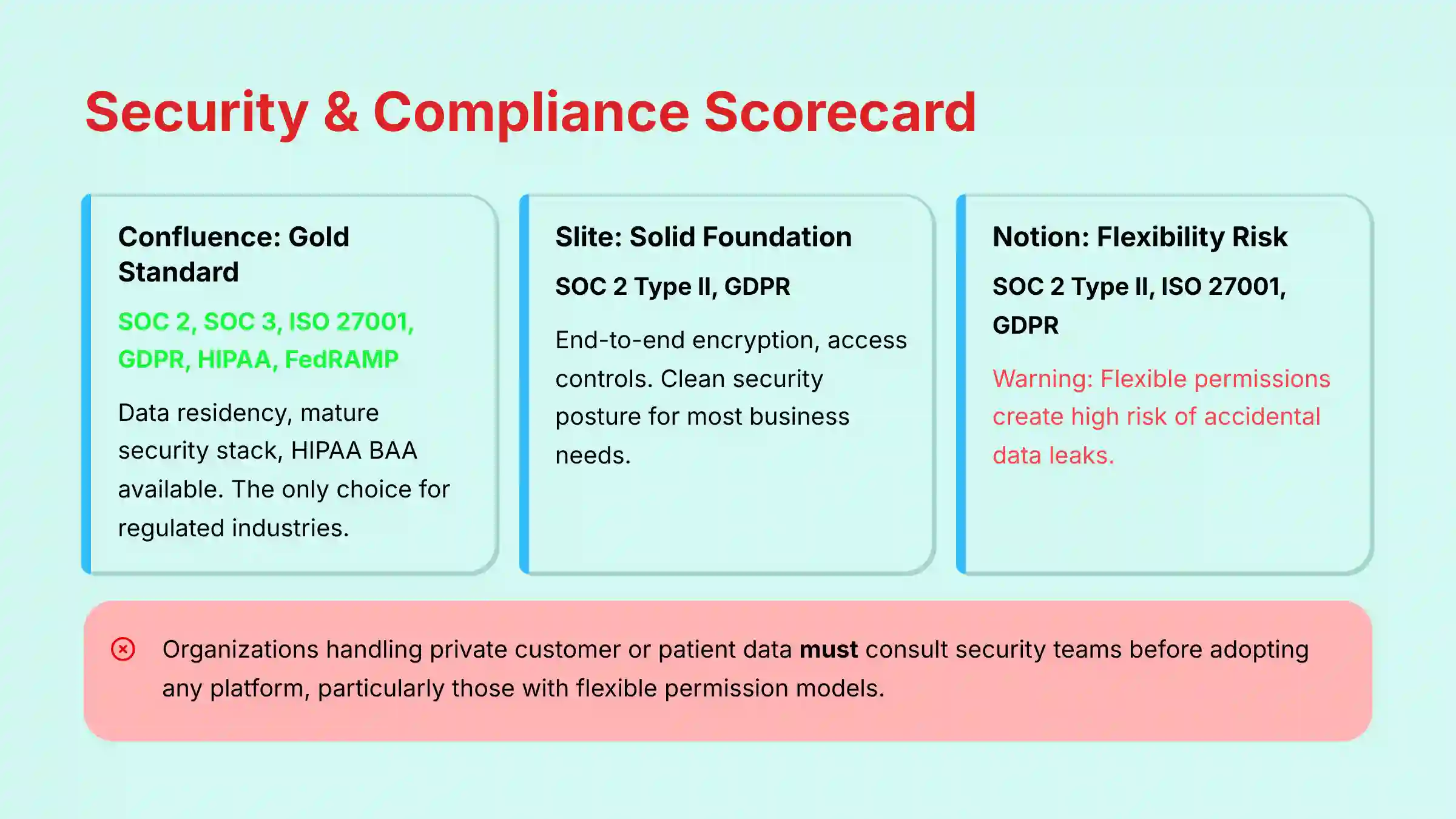
Certifications like SOC 2 and ISO 27001 are important signals of a vendor’s commitment to security. They show that a third party has audited their security practices.
Here is how the tools compare based on official documentation:
| Tool | Key Certifications | Data Governance & Advanced Compliance |
|---|---|---|
| Slite | SOC 2 Type II, GDPR | End-to-end encryption, access controls |
| Notion | SOC 2 Type II, ISO 27001, GDPR | SSO, role-based access |
| ClickUp | SOC 2 Type II, GDPR, HIPAA (Enterprise Plan) | Audit logs, SSO, encryption |
| Confluence | SOC 2, SOC 3, ISO 27001, ISO 27018, GDPR, HIPAA, FedRAMP | Data residency, mature Atlassian security stack, HIPAA BAA available, FedRAMP authorization |
| Guru | SOC 2 Type II, GDPR | Encryption at rest and in transit |
Real-World Risk Analysis: Beyond the Spec Sheet
Certifications are only part of the story. Real-world implementation reveals practical risks that spec sheets don’t mention.
In our professional opinion, these are the most pressing risks for each platform:
Notion has a high risk of accidental data leaks. We have spoken with an operations manager who confirmed a personal information leak happened because a team member mistakenly made a database public.
Its flexible permissions are a liability for any sensitive data.
For Slite, the main concern is one of perception. As a smaller vendor, it faces more questions from enterprise security teams about its ability to handle a major security incident compared to giants like Atlassian.
With Guru, the risk is operational. If your team does not maintain the verification workflow, employees could share outdated or wrong information with customers.
This poses a direct financial risk.
Beyond foundational certifications, product leaders in regulated sectors must scrutinize platform-specific compliance. For instance, teams handling Protected Health Information (PHI) require a platform that offers HIPAA compliance and is willing to sign a Business Associate Agreement (BAA).
Currently, Confluence Cloud Premium/Enterprise offers this, making it a default choice for many health-tech firms.
Similarly, organizations contracting with the US government should look for FedRAMP authorization, a level of security that smaller vendors have not yet achieved.
Always verify that the vendor’s compliance extends to their AI sub-processors and data handling policies, especially concerning how AI models are trained.
Organizations handling private customer or patient data must consult with their security and compliance teams before adopting any platform, particularly those with flexible permission models like Notion.
Financial Analysis: Total Cost of Ownership (TCO) & Hidden Fees
The price you see on the website is rarely the final price you pay. AI features and advanced security are often expensive add-ons that can dramatically increase your bill.
This analysis uncovers the true cost.
Pricing Model Comparison: Uncovering the True Cost
Many tools use a low starting price to attract users. They then lock essential features behind more expensive plans.
This table breaks down the real financial picture:
| Tool | Advertised Starting Price | Key Features Behind Paywall | Typical TCO Multiplier (for AI/Security) |
|---|---|---|---|
| Slite | $8/user/month | Advanced AI search, enterprise features | 1.5x |
| Notion | $10/user/month | AI is a costly add-on | 2.0x |
| ClickUp | $7/user/month | AI and security features | 2.5x – 3.0x |
| Confluence | $6.05/user/month (Standard plan 1-100 users) | Advanced security and integrations | 1.8x |
| Guru | $6/user/month | AI enhancements, advanced security | 1.7x |
The AI Add-on Trap: How TCO Can Double
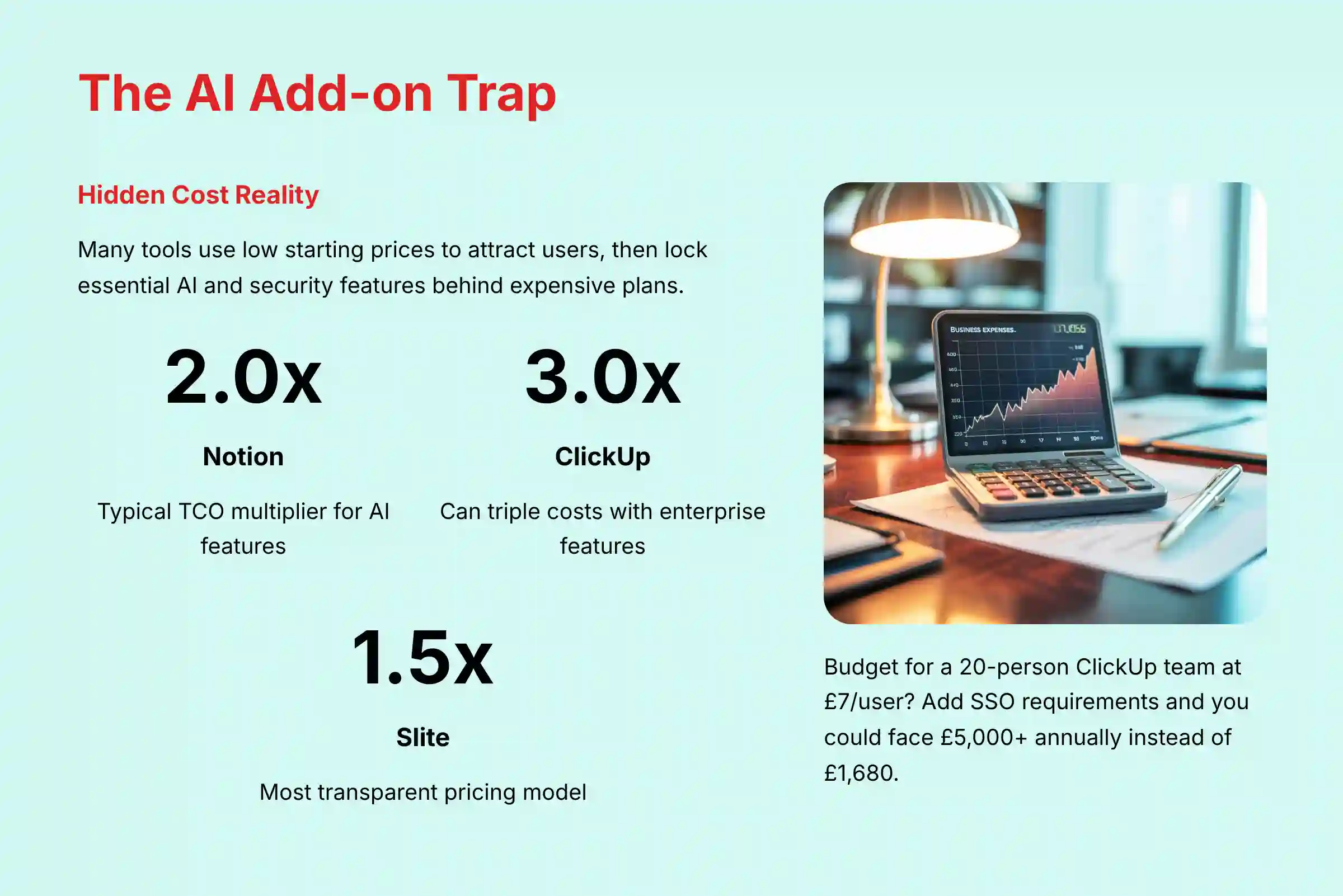
The biggest financial risk we’ve identified is what we call the “AI Add-on Trap,” most present with Notion and ClickUp.
Users report that adding Notion’s AI feature for a full team can nearly double the annual bill.
Let’s put this into a real-world context. Imagine you’ve budgeted for a 20-person team on ClickUp’s $7/user plan, expecting a cost of around $1,680 per year.
Three months in, your security team mandates SSO, which is only on the Enterprise plan. Suddenly, you’re not just adding the AI features; you’re forced into a price tier that could triple your annual cost to over $5,000.
That’s the problem. It’s a budget variance that’s difficult to explain and can erode trust in your procurement process.
Similarly, users of ClickUp often complain about a “bait-and-switch” model. The low-cost plans are functional until you need a basic enterprise feature like single sign-on.
At that point, you are forced onto a much more expensive plan, which can cause budget problems.
AI for Analytics & Reporting: From Historical Data to Predictive Insights
A critical differentiator for AI project management tools is their ability to move beyond simple burndown charts and provide predictive analytics.
This is where AI offers a true strategic advantage by identifying risks before they become issues:
- ClickUp and Confluence (via Jira integration) are leading this charge with predictive risk assessment. Their AI models can analyze project progress, task dependencies, and historical team performance to flag tasks that are at high risk of delay. This allows Project Managers to proactively manage bottlenecks rather than react to them.
- Notion, while powerful for custom dashboards, currently lacks native predictive capabilities. Teams must rely on third-party integrations or manual analysis to forecast project outcomes.
- Slite and Guru are not designed for project analytics. Their focus is on the accessibility and verification of knowledge, not the forecasting of project delivery timelines. For leaders whose primary concern is on-time project completion rates, the predictive capabilities found in more execution-focused tools represent a significant ROI.
Final Analysis: Strengths, Weaknesses & Optimal Use Cases

Every tool has a specific job it does best. This final breakdown summarizes where each platform shines and where it falls short.
Use this to match a tool’s strengths to your team’s primary need.
When to Choose Slite
- Key Strengths:
- It is incredibly simple and fast
- Its AI search provides accurate, contextual answers
- The clean user interface reduces mental load and encourages people to use it
- Key Weaknesses:
- It is not a project management tool, which can fracture workflows
- It has fewer integrations than Notion or ClickUp
- Search can slow down with a very large number of documents
- Optimal Use Case: Internal Knowledge Hubs. It is perfect for HR policies, onboarding guides, and team wikis where clarity and fast information retrieval are most important.
When to Choose Notion
- Key Strengths:
- It offers ultimate flexibility for creative teams
- Its generative AI is a strong partner for drafting and summarizing
- It has a rich ecosystem of templates and integrations
- Key Weaknesses:
- There is a high security risk from poor governance that can lead to data leaks
- It can become chaotic without a dedicated manager
- It slows down with large databases
- Optimal Use Case: Agile & Creative Teams. Ideal for product roadmaps and marketing campaigns where flexibility is key and data is not highly sensitive. Warning: Avoid for personal information or regulated data.
When to Choose ClickUp
- Key Strengths:
- Its AI is embedded directly into project tasks
- It combines tasks, documents, and goals in one place
- It connects to over 1,000 other tools
- Key Weaknesses:
- Users constantly complain about lag and instability
- The high feature density leads to a steep learning curve
- Essential features are locked behind expensive plans
- Optimal Use Case: Integrated Project Execution. For teams wanting a single platform to manage projects and documents, if they can tolerate the performance issues.
When to Choose Confluence
- Key Strengths:
- It provides ironclad security and compliance
- It has deep Jira integration, which is unbeatable for engineering teams
- It is trusted to handle massive knowledge bases
- Key Weaknesses:
- The editor and interface feel dated and slow
- Its restrictive structure can stifle creative documentation
- It is less effective without using other Atlassian tools
- Optimal Use Case: Enterprise & Regulated Industries. The mandatory choice for technical documentation and compliance records where auditability is the top priority.
When to Choose Guru
- Key Strengths:
- It surfaces verified info right where users work
- Its AI-powered verification actively fights knowledge decay
- It can measurably improve sales and support team efficiency
- Key Weaknesses:
- It has a niche application and is not a general-purpose tool
- Its AI suggestions still need expert approval
- If not maintained, it can cause more harm than good
- Optimal Use Case: Revenue-Facing Teams (Sales & Support). Unmatched for providing instant, accurate answers to customer-facing teams.
Professional Recommendation: Making the Right Choice for Your Team
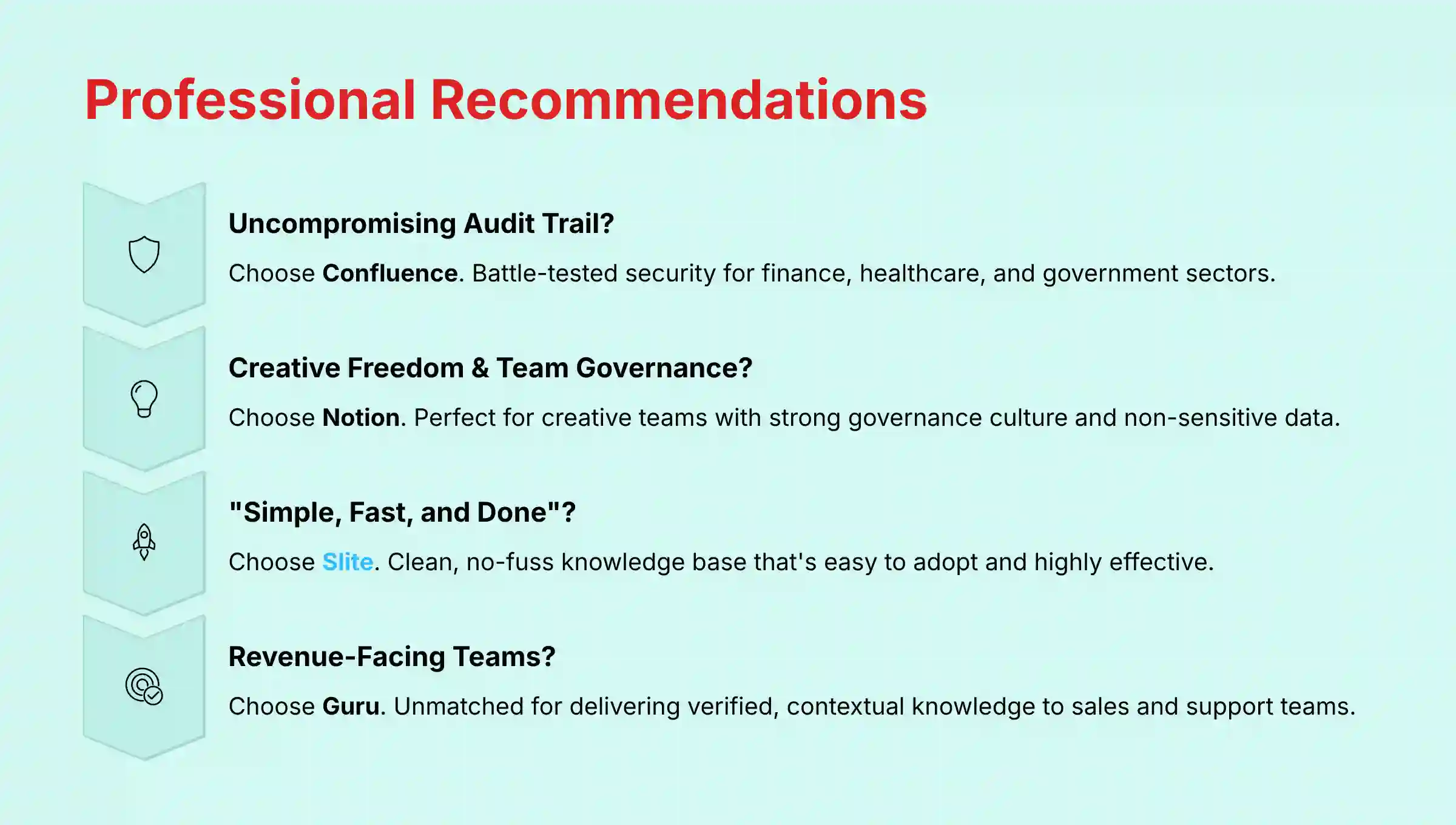
Our final recommendation depends on your organization’s primary need and tolerance for risk. There is no single “best” tool, only the right tool for a specific job.
Is an Uncompromising Audit Trail Your Top Priority?
Choose Confluence. Its security posture is battle-tested and trusted. It is the only choice for organizations in finance, healthcare, or government that handle sensitive data.
Do You Need Creative Freedom and Trust Your Team’s Governance?
Choose Notion. It is the leader for creative and product teams. But this choice requires a strong culture of governance and a clear understanding of its security limitations.
Is “Simple, Fast, and Done” Your Team’s Mantra?
Choose Slite. It is the ideal solution for teams that need a clean, no-fuss knowledge base. It is easy to adopt and very effective for its intended purpose.
For Integrated Project & Document Management
Choose ClickUp. It offers the most complete all-in-one solution. But you must be prepared for performance trade-offs and a higher-than-expected total cost.
For Revenue-Facing Teams (Sales & Support)
Choose Guru. It stands alone in its ability to deliver verified, contextual knowledge. This directly improves the performance of front-line teams and customer satisfaction.
What Other Factors Should Influence Your Decision? (Contextual Bridge)
Beyond the core features, you should also think about your team’s culture. A highly disciplined team might succeed with a flexible tool like Notion.
A team that values speed above all else might prefer the simplicity of Slite. The best tool will not only fit your workflow but also your team’s way of working.
When implementing any of these platforms, it’s critical to align the deployment with your specific methodology. For Agile teams using Scrum or Kanban, consider how the tool will support your sprint planning, daily standups, and retrospectives.
The right tool should enhance these ceremonies rather than forcing you to adapt your proven processes to fit its limitations.
For teams looking to dive deeper into implementation strategies, our comprehensive guide on Slite Top Alternatives and Competitors provides additional context for making the best decision for your specific needs.
Frequently Asked Questions (FAQs) About Slite and Its Competitors
What is the main difference between Slite and Notion?
The main difference is focus versus flexibility. Slite is designed specifically as a clean and simple knowledge base with great search.
Notion is a flexible, all-in-one workspace that can be a knowledge base, a project manager, and more, but it requires much more effort to keep organized.
Is Confluence still relevant in 2025 with modern tools like Slite?
Yes, absolutely. For large enterprises, especially those in regulated industries like finance or healthcare, Confluence is still the standard.
Its security, compliance features, and deep integration with Jira are capabilities that modern, simpler tools like Slite do not offer at the same level.
How does Slite’s AI search compare to Guru’s contextual knowledge?
Slite’s AI search is designed to find answers within your company’s internal documentation. It is great for looking up HR policies or project specs.
Guru’s AI is designed to push verified, bite-sized answers to users in the tools they already use, like a CRM or email client. Slite is for pulling information; Guru is for pushing it.
Is Notion secure enough for enterprise use?
In our professional opinion, no, not for sensitive or regulated data. While Notion has certifications like SOC 2 and ISO 27001, its core permission model is fundamentally designed for flexibility, not granular control.
This creates an unacceptably high risk of accidental data exposure for PII, PHI, or financial records.
Without an expert-level, dedicated administrator constantly auditing permissions, it is unsuitable for enterprise use in regulated industries. For these use cases, Confluence remains the only professionally responsible choice.
Which Slite alternative has the best integration with Jira?
Confluence has the best integration with Jira by a wide margin. Both are made by Atlassian and are designed to work together seamlessly.
This tight integration is a primary reason why engineering and technical teams continue to rely on the Atlassian suite.
Can ClickUp completely replace the need for a separate tool like Slite or Confluence?
ClickUp can replace the need for a separate documentation tool for some teams. It has a built-in Docs feature.
However, it is not as powerful as a dedicated knowledge base like Confluence for technical documentation, nor as simple as Slite for a company wiki.
Many large teams still use ClickUp for project management and Confluence for knowledge.
What are the hidden costs to watch out for with Notion and ClickUp?
With Notion, the main hidden cost is the AI add-on, which can nearly double your bill.
For ClickUp, the hidden costs come from needing to upgrade to expensive higher-tier plans to get essential business features like SSO, advanced security, and useful AI capabilities.
For a startup, should I start with Slite or Notion?
For a startup, the choice depends on your team’s discipline. If you need a simple, organized place for your core company information from day one, start with Slite.
If your team is more creative and you trust them to build and maintain their own systems, Notion offers more long-term flexibility. Just be aware of the security risks as you grow.
Important Disclaimers:
Technology Evolution Notice: The information about Slite Top Alternatives and Competitors and AI For Project & Product Management tools presented in this article reflects our thorough analysis as of 2025.
Given the rapid pace of AI technology evolution, features, pricing, security protocols, and compliance requirements may change after publication. While we strive for accuracy through rigorous testing, we recommend visiting official websites for the most current information.
Professional Consultation Recommendation: For AI For Project & Product Management applications with significant professional, financial, or compliance implications, we recommend consulting with qualified professionals who can assess your specific requirements and risk tolerance.
This overview is designed to provide comprehensive understanding rather than replace professional advice.
Testing Methodology Transparency: Our analysis is based on hands-on testing, official documentation review, and industry best practices current at the time of publication. Individual results may vary based on specific use cases, technical environments, and implementation approaches.
Final Verdict & Future Outlook
In 2025, choosing a collaboration tool is a clear exercise in managing trade-offs. The decision is a balance between the governance of Confluence, the flexibility of Notion, the simplicity of Slite, the integration of ClickUp, and the context of Guru.
There is no single right answer, only the answer that best fits your team’s specific needs and risk profile.
Looking ahead, AI will become even more deeply embedded in all of these platforms. The future competition will be about which tool’s AI can best automate workflows and provide predictive insights.
But your professional responsibility remains the same. You must perform thorough due diligence tailored to your organization’s unique security and compliance requirements.
To learn more about how these platforms compare, you can read our full analysis of Slite Top Alternatives and Competitors.


Leave a Reply