Is Kantata The Right AI Platform For Your Services Business?
Take This Quick Quiz To Find Out!
Key Takeaways
- AI-Powered PSA Platform: Kantata leverages AI for predictive forecasting, intelligent resource management, and risk detection to transform professional services delivery from reactive to proactive operations.
- Smart Resource Allocation: The platform automates resource matching by analyzing skills, availability, experience, and costs to maximize billable utilization and project profitability.
- Enterprise Integration: Seamless integrations with Salesforce, Jira, NetSuite, and QuickBooks enable end-to-end visibility across sales, delivery, and finance operations.
- Enterprise-Grade Security: SOC 2 Type II, ISO 27001 certified, and GDPR compliant with robust encryption and granular access controls to protect sensitive project and financial data.
- Proven ROI: Organizations report 10-20% improvements in billable utilization, enhanced project profitability margins, and reduced administrative overhead through automation.
Kantata is transforming how professional services organizations manage projects and resources through advanced AI capabilities. This comprehensive FAQ guide addresses the most critical questions about Kantata’s overview and features, helping you understand how this AI-powered Professional Services Automation platform can revolutionize your operations.
What is Kantata and how does it use AI for professional services automation?
Kantata is a comprehensive software platform tailored for professional services organizations to manage the full project lifecycle—from sales and scoping to delivery, resource optimization, and financial performance analysis.
Unlike generic project management tools, Kantata is a Professional Services Automation (PSA) solution designed specifically to support service-centric businesses where project profitability and utilization are critical.
The core AI capabilities of Kantata are embedded in the Kantata Cloud for Professional Services™ platform. This AI leverages historical project data, real-time resource availability, and ongoing project metrics to provide valuable predictive insights that help organizations transition from reactive management to proactive decision-making.
Key AI-driven features include:
- Predictive Forecasting: By analyzing past project trends and current states, Kantata’s AI predicts profitability margins, highlights potential budget overruns, and forecasts revenue. This enables decision-makers to monitor early warning signs before projects negatively impact margins.
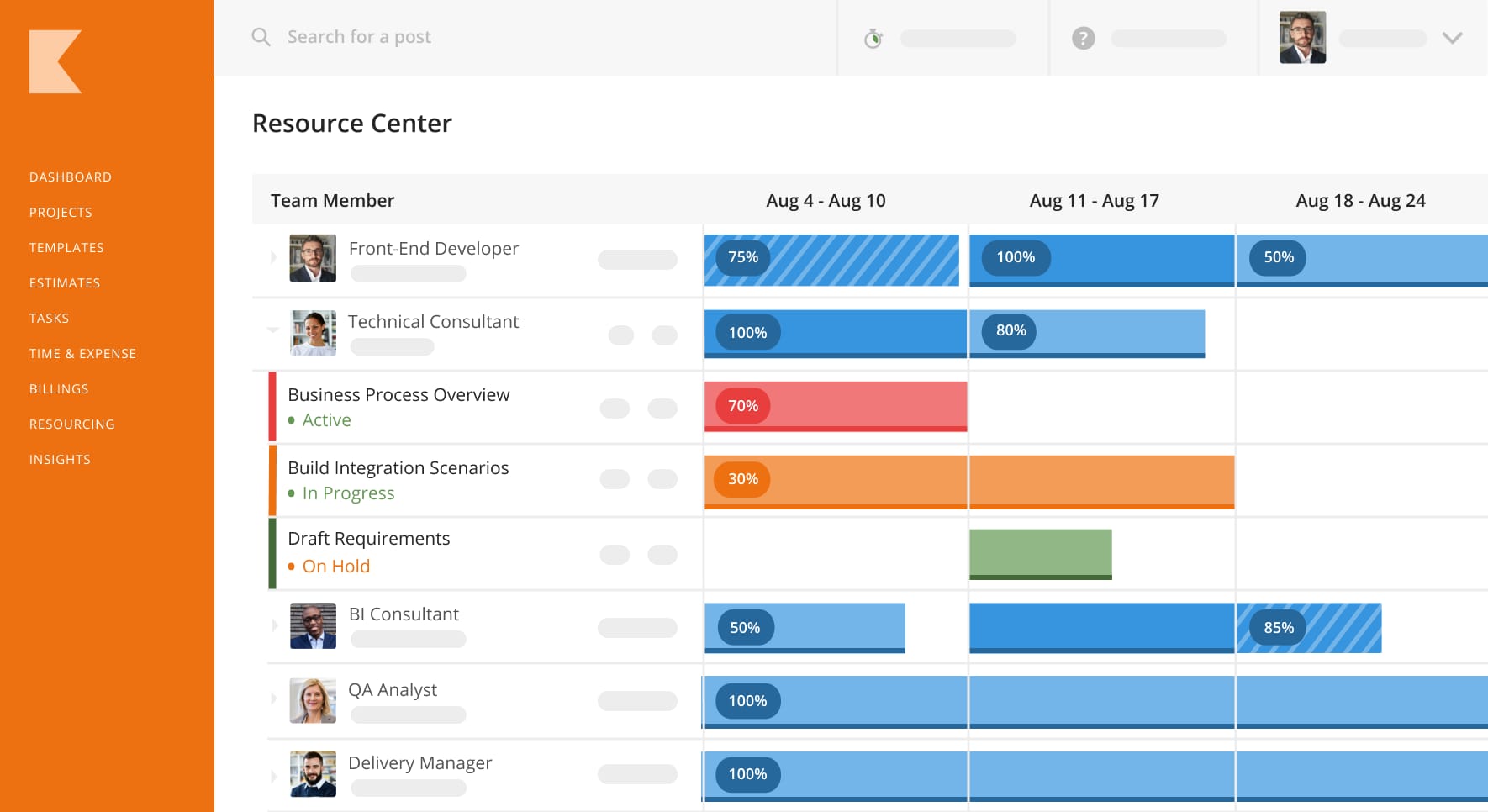
- Intelligent Resource Management: The system automates resource allocation by recommending the best-fit team members based on skill sets, availability, experience, and cost considerations. This optimization prevents overbooking and prevents burnout, ensuring projects are staffed effectively for successful delivery.
- Risk Detection: Kantata’s AI flags projects at risk of delay, budget issues, or resource bottlenecks, allowing managers to intervene early and course-correct through actionable insights.
Together, these AI capabilities help professional services firms improve project success rates, maximize billable utilization, and enhance financial outcomes by streamlining complex decision-making processes with data-driven automation.
Who is the ideal user for Kantata’s AI-powered platform?
Kantata is purpose-built for professional services organizations and embedded service teams that sell expertise and bill clients based on time and deliverables.
The platform’s features are tailored to those whose business performance directly correlates to optimized project execution and resource utilization.
The ideal users include:
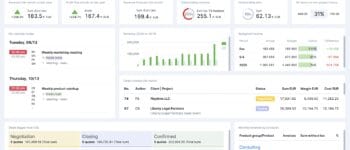
- Management & Operations Leaders (COOs, VPs of Services): They rely on Kantata for strategic oversight into project portfolios, capacity planning, revenue forecasting, and business health. The AI-powered dashboards provide real-time metrics to improve billable utilization and profitability, helping leadership make more informed operational decisions.
- Project & Product Managers: These are the day-to-day users managing timelines, assigning resources, tracking budgets, and monitoring project progress. The AI automates complex scheduling, suggests realistic delivery timelines, and highlights risk areas, freeing managers from manual spreadsheet work and enabling focus on client and team coordination.
- Team Members and Contributors: Consultants, engineers, designers, and other contributors benefit from Kantata’s centralized task views, clear priorities, and simplified time tracking. By reducing administrative overhead, team members can focus more on client work and deliverables.
Professional services companies such as marketing agencies, IT consultancies, software implementation firms, architecture, and engineering firms are particularly well-suited for Kantata. By embedding AI-powered forecasting and resource management in their workflows, these organizations can transform project delivery into a proactive, profitable engine. For a comprehensive look at what makes Kantata stand out, explore our detailed Kantata review of its AI PSA capabilities.
How does Kantata’s AI specifically assist in resource management and allocation?
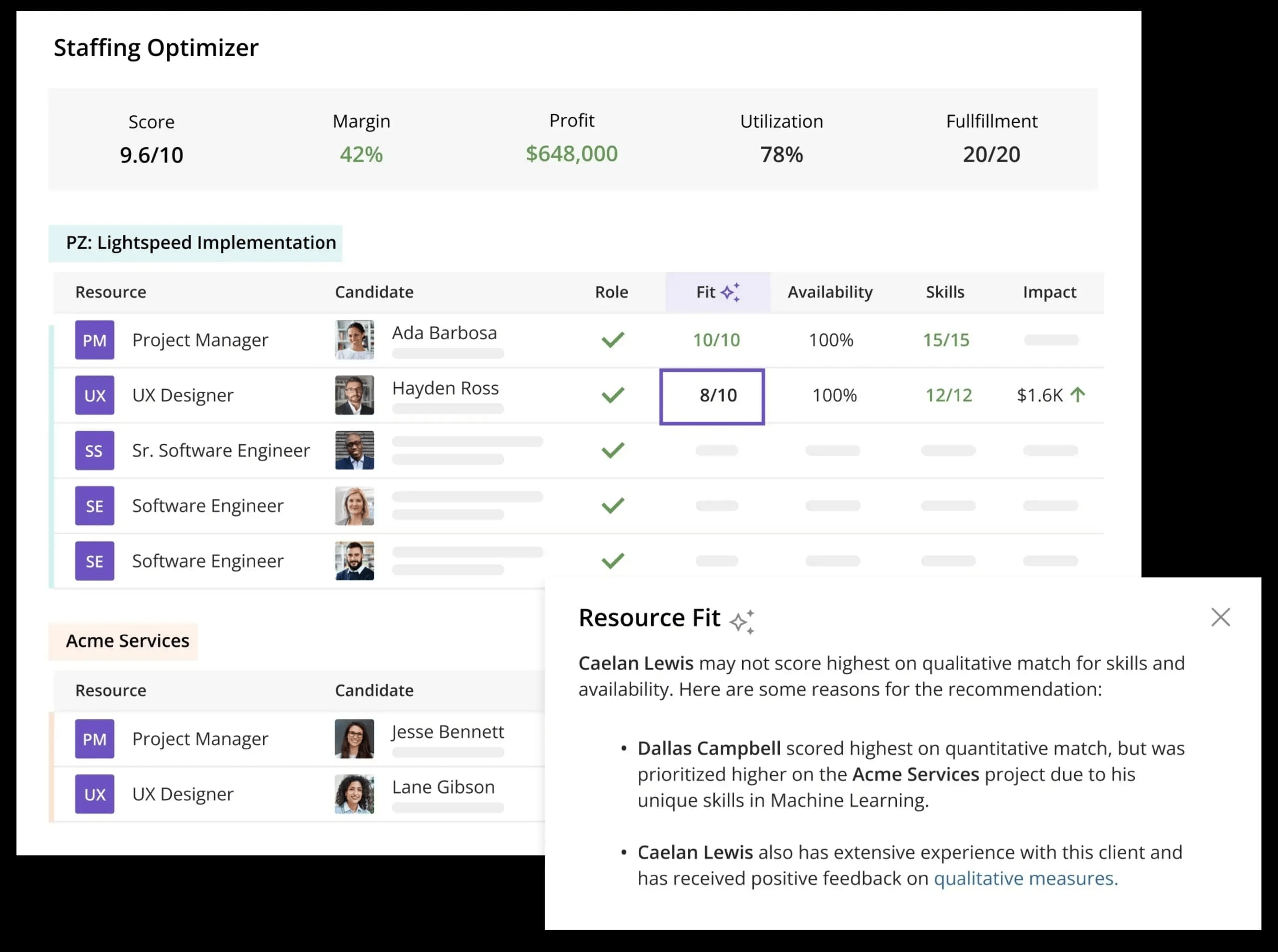
Kantata’s AI delivers a sophisticated solution to the perennial challenge of matching the right talent with the right projects at the right time—critical for maximizing billable utilization and project success in professional services.
Here’s how the AI-driven resource management works:
- Comprehensive Talent Profiles: Each employee profile includes detailed skills (e.g., Agile certification, Salesforce expertise), experience levels, billing rates, and preferences. This rich data foundation enables nuanced matching beyond simple availability calendars.
- AI-Powered Matching: When a project requires specific roles, the AI analyzes the entire resource pool and generates a ranked shortlist of best-fit candidates. It balances multiple factors including skill alignment, workload forecasts to avoid over-utilization, and cost considerations to protect project profitability.
- Capacity Forecasting: The system forecasts future availability and demand weeks or months ahead, identifying impending resource constraints or capacity surpluses. This insight empowers proactive hiring, training, or reallocation decisions rather than reactive firefighting.
- Scenario Planning: Managers can simulate “what-if” scenarios—for example, the impact of winning a large deal on current resources—to visualize workload shifts and identify potential shortfalls or bottlenecks before they occur.
This AI-driven approach automates complex decision-making and prevents human error, improving utilization rates and reducing staff burnout. It ensures that projects are staffed efficiently with appropriately skilled consultants, directly contributing to better delivery outcomes and enhanced profitability.
What are the limitations of Kantata’s AI, and are there risks of over-reliance?
While Kantata’s AI is a powerful tool for predictive insights and automation, it is important to understand its boundaries and mitigate risks associated with over-reliance.
Key limitations include
- Data Quality Dependence: AI outputs are only as good as the input data. Inaccurate or incomplete time tracking, infrequent status updates, or inconsistent expense logging will reduce forecast accuracy. Kantata’s AI cannot compensate for poor data hygiene.
- Historical Bias: The AI learns from recorded past projects. If past data reflects inefficiencies or biased staffing decisions, the AI might perpetuate these trends without human intervention. For example, it may under-recommend certain team members unless their profiles are actively managed.
- Lack of Qualitative Nuance: AI analyzes numerical data but cannot interpret interpersonal dynamics, client relationships, or sudden market shifts that affect project success. Human judgment remains essential to contextualize AI insights.
- Risk of Blind Trust: Viewing AI results as infallible and ignoring team input or common sense can lead to poor decisions. The AI is a decision-support tool, not a replacement for human oversight and experience.
Practical advice for users
Begin using Kantata’s AI early with your current data—even if imperfect—as this will surface where processes need improvement, such as inconsistent time entries.
Continually refine your data quality and combine AI insights with stakeholder feedback to make balanced decisions.
Treat the AI as a co-pilot that amplifies human intelligence rather than an autopilot replacing it. If you’re evaluating whether Kantata is the right fit for your needs, consider examining Kantata’s top alternatives and competitors to make an informed choice.
How does Kantata integrate with other tools like Salesforce and Jira, and how does AI leverage that data?
Kantata is designed to be a seamless central hub in a professional services technology ecosystem. Its integrations with key platforms amplify AI intelligence by providing end-to-end visibility and data flow across business functions—from sales to delivery to finance.
Salesforce Integration
Kantata offers a robust integration with Salesforce CRM that automates the “quote-to-cash” process. When a sales opportunity is marked as “Closed-Won” in Salesforce, Kantata can automatically create a corresponding project with detailed budget, scope, and client data. This eliminates manual project setup and errors.
The AI uses this synchronized data to anchor profitability forecasts, revenue burn rates, and resource allocation models based on real sales pipelines and commitments.
Jira Integration
For organizations delivering software projects, Kantata integrates bidirectionally with Jira to sync development tasks with project plans. Developers’ logged time in Jira flows automatically into Kantata’s timesheets, ensuring accurate resource utilization data.
AI forecasting leverages this real-time progress data to update budget forecasts and flag potential risks, providing project managers with a complete and current picture without dual data entry.
Additional Integrations
Kantata also connects with accounting systems like NetSuite and QuickBooks for invoicing and financial reconciliation, and communication platforms like Slack for collaboration and alerts.
AI Amplification
Integrations enrich Kantata’s AI models with multidimensional data, improving the accuracy of forecasting and the relevance of alerts. A powerful best practice is configuring bi-directional data flows—for example, pushing Kantata’s project health metrics back into Salesforce—to enable sales and account teams to monitor client profitability post-sale without leaving their CRM.
What security and compliance certifications does Kantata have?
Security and compliance are foundational to Kantata as it manages sensitive project financials, client data, and internal workflows. To address enterprise-grade security requirements, Kantata adheres to the highest industry standards, demonstrating its commitment to data protection and operational reliability.
Key certifications and compliance measures include:
- SOC 2 Type II Certification: Kantata undergoes rigorous third-party audits validating effective controls over the security, availability, processing integrity, confidentiality, and privacy of customer data. This attests to sustained operational excellence, not just a point-in-time snapshot.
- ISO 27001 Certification: This globally recognized standard confirms that Kantata follows a risk-based Information Security Management System (ISMS), continuously assessing and mitigating security threats to company and customer information.
- GDPR Compliance: Kantata meets the stringent requirements of the European Union’s General Data Protection Regulation, ensuring clients can manage personal data rights effectively, including data access, correction, and deletion requests.
- Granular Access Controls: The platform provides fine-tuned, role-based permissions down to project, task, and financial entry levels. Administrators can control who views or edits sensitive information, reducing insider risk.
- Data Encryption: All data is encrypted both in transit and at rest using industry-standard protocols, protecting against unauthorized access.
- Operational Reliability: Kantata maintains strong uptime SLAs, backup, and disaster recovery plans to ensure business continuity for critical professional services operations.
These combined measures provide strong assurance that Kantata handles client and project information with enterprise-grade security and compliance, suitable for regulated industries and large organizations.
What is the pricing model for Kantata, and are AI features an add-on?
Kantata employs a customizable pricing model based on the specific needs and scale of professional services organizations, rather than public, fixed tiers. Pricing is typically provided via a tailored quote after consultation with the sales team.
Key aspects of Kantata’s pricing structure
- User-Based Licensing: Costs depend primarily on the number and types of users. Full users (project managers, operations leaders) generally pay higher rates for access to complete functionality, while collaborator or team member licenses—used mainly for time and task entry—have lower fees.
- Solution Offerings: Kantata’s product lineup includes solutions like Kantata SX and Kantata PX, which address different market segments and organizational complexities. Each solution embeds AI-powered features appropriate to the customer’s operational scale and maturity.
- AI Features Included: AI-driven forecasting, resource optimization, and risk detection capabilities are considered core components and are included within Kantata’s main solution packages. They are not sold as separate premium add-ons. However, the depth and granularity of AI analytics may vary based on the solution and configuration.
- Integration Complexity: Costs may increase depending on the number and sophistication of integrations required (e.g., Salesforce, Jira, financial systems).
- Total Cost of Ownership: Prospective buyers should consider license fees, implementation and data migration expenses, plus ongoing training and support while calculating ROI.
Because Kantata’s pricing is consultative and tailored, organizations should engage directly with the vendor to receive accurate cost assessments aligned with their strategic needs and AI feature expectations.
Is there verifiable evidence or case studies on the ROI of using Kantata’s AI?
Yes. Kantata publishes verified case studies and customer success stories that substantiate measurable ROI generated through its AI-driven Professional Services Automation platform. These documented outcomes provide practical validation for business leaders evaluating the investment.
Typical ROI indicators include:
- Increased Billable Utilization: Clients consistently report improvements in utilization rates, often by 10–20%, by leveraging Kantata’s AI to optimize resource assignments and forecast demand more accurately. Reduced bench time directly increases revenue without raising headcount.
- Improved Project Profitability: Early detection of budget overruns and margin risks enables timely corrective actions. Case studies demonstrate significant margin expansion after adopting Kantata—sometimes boosting average project margins by several percentage points.
- Reduction in Administrative Overhead: Automation of scheduling, status reporting, and data synchronization reduces hours spent on manual tasks. This frees project managers and staff to focus on higher-value strategic work.
- Enhanced Forecast Accuracy: Business leaders gain data-driven confidence in capacity planning and financial projections. Improved visibility supports better hiring, investment, and client engagement decisions.
Prospective customers should request case studies from Kantata that closely match their industry, company size, and business model. Additionally, speaking to current clients during the sales process is recommended to understand tangible benefits and best practices. For practical guidance on maximizing your Kantata investment, check out our Kantata tutorials and use case guide.
What is the typical implementation process and timeline for Kantata?
Implementing Kantata is a collaborative, structured process designed to configure the platform to an organization’s unique workflows and ensure adoption of its AI capabilities through clean data and user readiness.
A typical implementation journey includes these phases:
- Discovery & Scoping (1–2 weeks): Consulting teams engage with stakeholders to document existing workflows, pain points, and goals. This lays the foundation for customizing project templates, resource models, and integrations.
- System Configuration & Integration (2–4 weeks): Based on discovery, the platform is configured for user roles, permissions, and process mappings. Critical integrations—such as Salesforce CRM and financial systems—are established to enable data flow.
- Data Migration (1–2 weeks): Historical data from legacy systems—including client lists, projects, time entries, and financial records—is extracted, cleansed, and imported. Data quality here directly influences AI forecasting accuracy at launch.
- Training & User Acceptance Testing (1–2 weeks): Different user groups receive tailored training. Pilot users test workflows in real-world scenarios, providing feedback to fine-tune configurations before full deployment.
- Go-Live & Post-Launch Support: The platform is officially launched with focused support to resolve issues quickly and encourage adoption.
Overall Timeline
Implementation duration varies by organization size and complexity:
- Small to Mid-sized: Approximately 6–8 weeks
- Large, Complex Organizations: 10–12 weeks or more, especially when numerous integrations or customizations are required
Clients with strong internal change management and clean historical data tend to experience faster and more successful implementations.
For a comprehensive understanding of how Kantata works in practice and to explore common implementation scenarios, visit our complete Kantata FAQs resource.
Ready to transform your professional services operations with AI-powered automation? Kantata provides the clarity, control, and confidence needed to maximize project profitability and resource utilization. Whether you’re managing complex project portfolios or seeking better resource optimization, Kantata’s AI-driven platform delivers measurable results.
For organizations serious about optimizing their professional services delivery, Kantata represents a strategic investment in operational excellence. If you’re looking for comprehensive solutions in AI task automation and management, Kantata stands out as a purpose-built platform designed specifically for professional services success.
This comprehensive Kantata FAQ is designed to assist professionals evaluating AI solutions for project and product management in professional services environments, supporting data-driven decisions with current, accurate, and actionable information.




Leave a Reply